Deep Blue Chess Software Download
Dec 11, 2017 Microsoft. The fiercely competitive software giant is positioning its wares for cloud computing with software and services. The company's two cash cows.
Part of a Left to right: white, black, black, white, black, white Years active c. 6th-century to present Genre(s) Players 2 Playing time Casual games usually last 10 to 60 minutes; tournament games last anywhere from about ten minutes () to six hours or more. Random chance None Skill(s) required, Chess is a two-player played on a, a checkered gameboard with 64 squares arranged in an 8×8 grid. The game is played by millions of people worldwide. Each player begins with 16: one, one, two, two, two, and eight.
Each of the six piece types differently, with the most powerful being the queen and the least powerful the pawn. The objective is to the opponent's king by placing it under an inescapable threat of capture. To this end, a player's pieces are used to attack and capture the opponent's pieces, while supporting each other.
In addition to checkmate, the game can be won by of the opponent, which typically occurs when too much is lost or checkmate appears inevitable. There are also several ways a game can end in a. Chess is believed to have originated in sometime before the 7th century.
The game was derived from the Indian game, which is also the likely ancestor of the Eastern strategy games,, and. (A minority view holds that chess originated in China.) The pieces assumed their current powers in Spain in the late 15th century; the rules were standardized in the 19th century. The first generally recognized,, claimed his title in 1886.
Since 1948, the World Championship has been regulated by, the game's international governing body. FIDE also awards life-time to skilled players, the highest of which is. Many national chess organizations have a title system of their own.
FIDE also organizes the, the, the, the, and the, a popular competition among international teams. There is also a and a. Online chess has opened amateur and professional competition to a wide and varied group of players. The FIDE is a member of the, which can be considered as a recognition of chess as a;. Several national sporting bodies (for example the Spanish ) also recognize chess as a sport.
Chess was included in the 2006 and 2010. Since the second half of the 20th century, with increasing success, to the point where the strongest personal computers play at a higher level than the best human players. Since the 1990s, computer analysis has contributed significantly to chess theory, particularly in the endgame. The IBM computer was the first machine to overcome a reigning World Chess Champion in a match when it in 1997. The rise of strong computer programs (called 'engines') runnable on hand-held devices has led to increasing concerns about during tournaments. There are many that utilize different rules, pieces, or boards.
One of these, (originally 'Fischerandom'), has gained widespread popularity as well as some FIDE recognition. Setup at the start of a game Chess is played on a square of eight rows (called and denoted with numbers 1 to 8) and eight columns (called and denoted with letters a to h). The colors of the 64 squares alternate and are referred to as light and dark squares.
The chessboard is placed with a light square at the right-hand end of the rank nearest to each player. By convention, the are divided into, and the players are referred to as White and Black respectively. Each player begins the game with 16 pieces of the specified color, which consist of one king, one queen, two rooks, two bishops, two knights, and eight pawns. The pieces are set out as shown in the and photo, with each queen on a square of its own color, the white queen on a light square and the black queen on a dark.
Movement The player with the white pieces always moves first. After the first move, players alternately move one piece per turn (except for, when two pieces are moved). Pieces are moved to either an unoccupied square or one occupied by an opponent's piece, which is captured and removed from play. With the sole exception of, all pieces capture by moving to the square that the opponent's piece occupies. A player may not make any move that would put or leave the player's own king under attack.
A player cannot 'pass'; at each turn one must make a legal move (this is the basis for the finesse called ). If the player to move has no legal move, the game is over; it is either a (a loss for the player with no legal moves) if the king is under attack, or a (a draw) if the king is not. Each has its own way of moving.
In the diagrams, the dots mark the squares where the piece can move if there are no intervening piece(s) of either color. 8 7 7 6 6 5 5 4 4 3 3 2 2 1 1 a b c d e f g h • The moves one square in any direction. The king also has a special move called that involves also moving a rook.
• The can move any number of squares along a rank or file, but cannot leap over other pieces. Along with the king, a rook is involved during the king's castling move. • The can move any number of squares diagonally, but cannot leap over other pieces. • The combines the power of a rook and bishop and can move any number of squares along a rank, file, or diagonal, but cannot leap over other pieces. • The moves to any of the closest squares that are not on the same rank, file, or diagonal, thus the move forms an 'L'-shape: two squares vertically and one square horizontally, or two squares horizontally and one square vertically. The knight is the only piece that can leap over other pieces. • The can move forward to the unoccupied square immediately in front of it on the same file, or on its first move it can advance two squares along the same file, provided both squares are unoccupied (black dots in the diagram); or the pawn can capture an opponent's piece on a square diagonally in front of it on an adjacent file, by moving to that square (black 'x's).
A pawn has two special moves: the en passant capture and. Examples of Once in every game, each king is allowed to make a special move, known as. Castling consists of moving the king two squares along the first rank toward a rook (which is on the player's first rank ) and then placing the rook on the last square that the king has just crossed. Castling is permissible under the following conditions: • Neither the king nor the rook have previously moved during the game. • There cannot be any pieces between the king and the rook. • The king cannot be in check, nor can the king pass through squares that are under attack by enemy pieces, or move to a square where it would result in a check.
Note that castling is permissible if the rook is attacked, or if the rook crosses a square that is attacked. Examples of pawn moves: (left); (right) When a pawn advances two squares from its starting position and there is an opponent's pawn on an adjacent file next to its destination square, then the opponent's pawn can capture it en passant (in passing), and move to the square the pawn passed over. This can only be done on the very next move, otherwise the right to do so is forfeit. For example, in the animated diagram, the black pawn advances two squares from g7 to g5, and the white pawn on f5 can take it via en passant on g6 (but only on White's next move). Main article: When a pawn advances to the eighth rank, as a part of the move it is promoted and must be exchanged for the player's choice of queen, rook, bishop, or knight of the same color. Usually, the pawn is chosen to be promoted to a queen, but in some cases another piece is chosen; this is called. After Earth 2013 Dvdrip Torrent Download. In the, the pawn on c7 can be advanced to the eighth rank and be promoted to an allowed piece.
There is no restriction placed on the piece that is chosen on promotion, so it is possible to have more pieces of the same type than at the start of the game (for example, two queens). The black king is in from the white rook. When a king is under immediate attack by one or two of the opponent's pieces, it is said to be in. A response to a check is a legal move if it results in a position where the king is no longer under direct attack (that is, not in check). This can involve capturing the checking piece; interposing a piece between the checking piece and the king (which is possible only if the attacking piece is a queen, rook, or bishop and there is a square between it and the king); or moving the king to a square where it is not under attack.
Castling is not a permissible response to a check. The object of the game is to checkmate the opponent; this occurs when the opponent's king is in check, and there is no legal way to remove it from attack. It is illegal for a player to make a move that would put or leave the player's own king in check. In casual games it is common to announce 'check' when putting the opponent's king in check, but this is not required by the rules of the game, and is not usually done in tournaments. End of the game Win.
White is in, being unable to escape attack by the black bishops. Games can be won in the following ways: •: The player whose turn it is to move is in check and has no legal move to escape check. •: Either player may resign, conceding the game to the opponent. It is usually considered poor etiquette to play on in a truly hopeless position, and for this reason high-level games rarely end in checkmate.
• Win on time: In games with a, a player wins if the opponent runs out of time, even if the opponent has a much superior position, as long as the player still has a theoretical possibility to checkmate the opponent. • Forfeit: A player who cheats, or violates the rules of the game, or violates the rules specified for the particular tournament can be forfeited. In high-level tournaments, players have been forfeited for such things as arriving late for the game (even by a matter of seconds), receiving a call or text on a cell phone, refusing to undergo a drug test, refusing to undergo a body search for electronic devices, and unsporting behavior (such as refusing to shake the opponent's hand). Black is not in check and has no legal move. The result is.
There are several ways games can end in a: •: Draws are most commonly reached by mutual agreement between the players. The correct procedure is to verbally offer the draw, make a move, then start the opponent's clock. Traditionally, players have been allowed to agree to a draw at any point in the game, occasionally even without playing a move; in recent years efforts have been made to discourage short draws, for example by forbidding draw offers before move thirty. •: The player whose turn it is to move has no legal move and is not in check. • of position: This most commonly occurs when neither side is able to avoid repeating moves without incurring a disadvantage.
In this situation, either player can claim a draw; this requires the players to keep a valid written record of the game so that the claim can be verified by the arbiter if challenged. The three occurrences of the position need not occur on consecutive moves for a claim to be valid. FIDE rules make no mention of; this is merely a specific type of draw by threefold repetition. •: If during the previous 50 moves no pawn has been moved and no capture has been made, either player can claim a draw.
There are several known endgames where it is possible to force a mate but it requires more than 50 moves before a pawn move or capture is made; examples include some endgames with and some such as queen against two bishops. Historically, FIDE has sometimes revised the 50-move rule to make exceptions for these endgames, but at present (as of 2017) no exceptions are made. Some organizations do not enforce the fifty-move rule.
• Fivefold repetition of position: Similar to the threefold-repetition rule, but in this case neither player needs to claim the draw; thus a tournament director can intervene and declare the game to be drawn. This is a relatively recent (2014) addition to the FIDE rules. • Seventy-five-move rule: Similar to the fifty-move rule; however, if the final move in the sequence resulted in checkmate, this takes precedence.
As with the fivefold-repetition rule, this applies independently of claims by the players, and allows a tournament director to intervene. This rule likewise is a recent addition to the FIDE rules. •: If neither player has a theoretical possibility to checkmate the opponent; for example, if a player has only the king and a knight left, and the opponent has only the king left, checkmate is impossible and the game is drawn by this rule.
On the other hand, if both players have a king and a knight left, there is a highly unlikely yet theoretical possibility of checkmate, so this rule does not apply. • Draw on time: In games with a, the game is drawn if a player is out of time and the opponent has no theoretical possibility to checkmate the player. Time control. Modern-day chess clocks Chess games may also be played with a.
If a player's time runs out before the game is completed, the game is automatically lost (provided the opponent has to deliver checkmate). The duration of a game ranges from long (or 'classical') games which can take up to seven hours (even longer if are permitted) to (under 3 minutes per player for the entire game). Intermediate between these are games, lasting between 20 minutes and two hours per game, a popular time control in amateur weekend tournaments. Time is controlled using a that has two displays, one for each player's remaining time. Analog chess clocks have been largely replaced by digital clocks, which allow for time controls with. Notation for recording moves. Square names in Chess games and positions are recorded using a system of notation, most commonly.
Abbreviated (or short) algebraic notation generally records moves in the format 'abbreviation of the piece moved – file where it moved – rank where it moved'. The pieces are identified by their initials. In English, these are K (King), Q (Queen), R (Rook), B (Bishop), and N (Knight; N is used to avoid confusion with King). For example, Qg5 means 'queen moves to the g-file and the 5th rank' (that is, to the square g5).
Chess literature published in other languages may use different initials to indicate the pieces, or may be used to avoid language difficulties. To resolve ambiguities, one more letter or number is added to indicate the file or rank from which the piece moved, e.g. Ngf3 means 'knight from the g-file moves to the square f3', and R1e2 means 'rook on the first rank moves to e2'.
The letter P for a pawn is not used, so that e4 means 'pawn moves to the square e4'. If the piece makes a capture, 'x' is inserted before the destination square. Thus Bxf3 means 'bishop captures on f3'. When a pawn makes a capture, the file from which the pawn departed is used in place of a piece initial, and ranks may be omitted if unambiguous. For example, exd5 (pawn on the e-file captures the piece on d5) or exd (pawn on the e-file captures a piece somewhere on the d-file). Particularly in Germany, some publications have used ':' rather than 'x' to indicate a capture, but this is now rare. Some publications omit the capture symbol altogether, so that exd5 would be rendered simply as 'ed'.
If a pawn moves to its last rank, achieving promotion, the piece chosen is indicated after the move, for example e1Q or e1=Q. Castling is indicated by the special notations 0-0 for castling and 0-0-0 for castling. An en passant capture is sometimes marked with the notation 'e.p.' A move that places the opponent's king in check usually has the notation '+' added. (The notation '++' for a is considered obsolete.) Checkmate can be indicated by '#'.
At the end of the game, '1–0' means 'White won', '0–1' means 'Black won', and '½–½' indicates a draw. ' Chess moves can be annotated with. For example, '!' Indicates a good move, '!!' An excellent move, '?' A mistake, '??'
A blunder, '!?' An interesting move that may not be best, or '?!' A dubious move not easily refuted. For example, one variation of a simple trap known as the (see animated diagram) can be recorded: 1. Qxf7# 1–0 The text-based (PGN), which is understood by chess software, is based on short form English language algebraic notation. Until about 1980, the majority of English language chess publications used a form of. In descriptive notation, files are named according to the piece which occupies the back rank at the start of the game, and each square has two different names depending on whether it is from White's or Black's point of view.
For example, the square known as 'e3' in algebraic notation is 'K3' (King's 3rd) from White's point of view, and 'K6' (King's 6th) from Black's point of view. When recording captures, the captured piece is named rather than the square on which it is captured (except to resolve ambiguities). Thus, Scholar's mate is rendered in descriptive notation: 1. QxBP# 1–0 A few players still prefer descriptive notation, but it is no longer recognized by FIDE. Another system is, recognized by the though its use is in decline.
Squares are identified by numeric coordinates, for example a1 is '11' and h8 is '88'. Moves are described by the 'from' and 'to' squares, and captures are not indicated. For example, the opening move 1.e4 is rendered as 1.5254.
Castling is described by the king's move only, for example 5171 for White castling kingside, 5838 for Black castling queenside. Strategy and tactics Chess strategy consists of setting and achieving long-term positioning advantages during the game – for example, where to place different pieces – while tactics concentrate on immediate maneuver. These two parts of the chess-playing process cannot be completely separated, because strategic goals are mostly achieved through tactics, while the tactical opportunities are based on the previous strategy of play. A game of chess is normally divided into three phases: opening, typically the first 10 moves, when players move their pieces to useful positions for the coming battle; then middlegame; and last the endgame, when most of the pieces are gone, kings typically take a more active part in the struggle, and pawn promotion is often decisive.
Fundamentals of tactics. 23.Bh5+ and now: • 23.Kxh5 24.Ng3+ Kh4 25.Qe4+ Rf4 26.Qxf4# • 23.Kf5 24.g4# • 23.Kh7 24.Nf6+ () Kh8 25.Qh7# In chess, tactics in general concentrate on short-term actions – so short-term that they can be calculated in advance by a human player or by a computer.
The possible depth of calculation depends on the player's ability. In quiet positions with many possibilities on both sides, a deep calculation is more difficult and may not be practical, while in 'tactical' positions with a limited number of forced variations, strong players can calculate long sequences of moves. Simple one-move or two-move tactical actions – threats, exchanges of, and double attacks – can be combined into more complicated, sequences of tactical maneuvers that are often forced from the point of view of one or both players.
Theoreticians describe many elementary tactical methods and typical maneuvers; for example,,,,, (especially discovered checks),,,,,,, and. A forced variation that involves a sacrifice and usually results in a tangible gain is called a. Brilliant combinations – such as those in the – are considered beautiful and are admired by chess lovers. A common type of chess exercise, aimed at developing players' skills, is showing players a position where a decisive combination is available and challenging them to find it. Fundamentals of strategy. Main article: Chess strategy is concerned with evaluation of chess positions and with setting up goals and long-term plans for the future play.
During the evaluation, players must take into account numerous factors such as the value of the pieces on the board, control of the center and centralization, the, king safety, and the control of key squares or groups of squares (for example, diagonals, open files, and dark or light squares). The most basic step in evaluating a position is to count the of both sides. The point values used for this purpose are based on experience; usually pawns are considered worth one point, knights and bishops about three points each, rooks about five points (the value difference between a rook and a bishop or knight being known as ), and queens about nine points. The king is more valuable than all of the other pieces combined, since its checkmate loses the game.
But in practical terms, in the endgame the king as a fighting piece is generally more powerful than a bishop or knight but less powerful than a rook. These basic values are then modified by other factors like position of the piece (e.g. Advanced pawns are usually more valuable than those on their initial squares), coordination between pieces (e.g.
A pair of bishops usually coordinate better than a bishop and a knight), or the type of position (e.g. Knights are generally better in with many pawns while bishops are more powerful in ). Example of underlying pawn structure. .and its pawn 'Rauzer formation' Another important factor in the evaluation of chess positions is the pawn structure (sometimes known as the pawn skeleton), or the configuration of pawns on the chessboard. Since pawns are the least mobile of the chess pieces, the pawn structure is relatively static and largely determines the strategic nature of the position. Weaknesses in the pawn structure, such as,, or and, once created, are often permanent.
Care must therefore be taken to avoid these weaknesses unless they are compensated by another valuable asset (for example, by the possibility of developing an attack). Main article: A chess opening is the group of initial moves of a game (the 'opening moves'). Recognized sequences of opening moves are referred to as openings and have been given names such as the. They are catalogued in reference works such as the. There are dozens of different openings, varying widely in character from quiet play (for example, the ) to very aggressive (the ). In some opening lines, the exact sequence considered best for both sides has been worked out to more than 30 moves. Professional players spend years studying openings and continue doing so throughout their careers, as continues to evolve.
The fundamental strategic aims of most openings are similar: • Development: This is the technique of placing the pieces (particularly bishops and knights) on useful squares where they will have an optimal impact on the game. • Control of the center: Control of the central squares allows pieces to be moved to any part of the board relatively easily, and can also have a cramping effect on the opponent.
• King safety: It is critical to keep the king safe from dangerous possibilities. A correctly timed castling can often enhance this. •: Players strive to avoid the creation of pawn weaknesses such as isolated, doubled, or backward pawns, and pawn islands – and to force such weaknesses in the opponent's position. Most players and consider that White, by virtue of the first move,.
This initially gives White the. Black usually strives to neutralize White's advantage and achieve, or to develop in an unbalanced position.
Main article: The middlegame is the part of the game which starts after the opening. There is no clear line between the opening and the middlegame, but typically the middlegame will start when most pieces have been developed.
(Similarly, there is no clear transition from the middlegame to the endgame; see.) Because the opening theory has ended, players have to form plans based on the features of the position, and at the same time take into account the tactical possibilities of the position. The middlegame is the phase in which most occur. Combinations are a series of tactical moves executed to achieve some gain.
Middlegame combinations are often connected with an attack against the opponent's king. Some typical patterns have their own names; for example, the or the combination. Specific plans or strategic themes will often arise from particular groups of openings which result in a specific type of pawn structure. An example is the, which is the attack of queenside pawns against an opponent who has more pawns on the queenside. The study of openings is therefore connected to the preparation of plans that are typical of the resulting middlegames. Another important strategic question in the middlegame is whether and how to reduce material and transition into an endgame (i.e.
Minor material advantages can generally be transformed into victory only in an endgame, and therefore the stronger side must choose an appropriate way to achieve an ending. Not every reduction of material is good for this purpose; for example, if one side keeps a light-squared bishop and the opponent has a dark-squared one, the transformation into a ending is usually advantageous for the weaker side only, because an endgame with is likely to be a draw, even with an advantage of a pawn, or sometimes even with a two-pawn advantage. The side having to move is at a disadvantage. The endgame (also end game or ending) is the stage of the game when there are few pieces left on the board. There are three main strategic differences between earlier stages of the game and the endgame: • Pawns become more important. Endgames often revolve around endeavors to a pawn by advancing it to the furthest.
• The king, which required safeguarding from checkmate in the middlegame, emerges as a strong piece in the endgame. It is often brought to the center of the board where it can protect its own pawns, attack enemy pawns, and hinder moves of the opponent's king. •, disadvantageous since it forces a player to move, is often a factor in endgames but rarely in other stages of the game. In the example diagram, either side having the move is in zugzwang: Black to move must play 1.Kb7 allowing White to promote the pawn after 2.Kd7; White to move must permit a draw, either by 1.Kc6 or by losing the pawn after any other legal move. Endgames can be classified according to the type of pieces remaining on the board. Are positions in which one side has only a king and the other side has one or two pieces and can checkmate the opposing king, with the pieces working together with their king.
For example, involve only kings and pawns on one or both sides, and the task of the stronger side is to promote one of the pawns. Other more complicated endings are classified according to pieces on the board other than kings, such as ' endgames. The uncheckered 8x8 board, sometimes with special marks, on which was played Chess is believed to have originated in, c.
280–550, in the, where its early form in the 6th century was known as (: चतुरङ्ग), literally four divisions [of the military] –,,, and, represented by the pieces that would evolve into the modern pawn, knight, bishop, and rook, respectively. Thence it spread eastward and westward along the.
The earliest evidence of chess is found in the nearby around 600, where the game came to be known by the name. Chatrang was taken up by the after the (633–44), where it was then named, with the pieces largely retaining their Persian names. In Spanish 'shatranj' was rendered as ajedrez ('al-shatranj'), in as xadrez, and in as ζατρίκιον ( zatrikion, which comes directly from the Persian chatrang), but in the rest of Europe it was replaced by versions of the Persian shāh ('king'), which was familiar as an exclamation and became the English words ' and 'chess'. The oldest archaeological artifacts, ivory chess pieces, were excavated in ancient, today's, in, central Asia, and date to about 760, with some of them possibly older. The oldest known chess manual was in Arabic and dates to 840–850, written by (800–870), a renowned Arab chess player, titled Kitab ash-shatranj (Book of the chess).
This is a lost manuscript, but referenced in later works. The eastern migration of chess, into China and Southeast Asia, has even less documentation than its migration west. The first reference to chess, called Xiang Qi, in China comes in the (玄怪录, record of the mysterious and strange) dating to about 800. Alternatively, some contend that chess arose from Chinese chess or one of its predecessors, although this has been contested. The game reached Western Europe and Russia by at least three routes, the earliest being in the 9th century. By the year 1000, it had spread throughout Europe.
Introduced into the by the in the 10th century, it was described in a famous 13th-century manuscript covering shatranj,, and named the. 1200–1700: Origins of the modern game. Playing chess,, 1283 Around 1200, the rules of shatranj started to be modified in southern Europe, and around 1475, several major changes made the game essentially as it is known today.
These modern rules for the basic moves had been adopted in Italy and Spain. Pawns gained the option of advancing two squares on their first move, while bishops and queens acquired their modern abilities. The replaced the earlier chess piece towards the end of the 10th century and by the 15th century had become the most powerful piece; consequently modern chess was referred to as 'Queen's Chess' or 'Mad Queen Chess'. Castling, derived from the 'kings leap' usually in combination with a pawn or rook move to bring the king to safety, was introduced.
These new rules quickly spread throughout western Europe. Were finalized in the early 19th century. Also in the 19th century, the convention that White moves first was established (formerly either White or Black could move first). Finally the rules around castling were standardized – variations in the castling rules had persisted in Italy until the late 19th century. The resulting standard game is sometimes referred to as Western chess or international chess, particularly in Asia where other games of the chess family such as are prevalent. Since the 19th century, the only rule changes have been technical in nature, for example establishing the correct procedure for claiming a draw by repetition. 18th-century French chess master The romantic era was characterized by opening gambits (sacrificing pawns or even pieces), daring attacks, and brazen sacrifices.
Many elaborate and beautiful but unsound move sequences called 'combinations' were played by the masters of the time. The game was played more for art than theory. A profound belief that chess merit resided in the players' genius rather than inherent in the position on the board pervaded chess practice. In the 18th century, the center of European chess life moved from the Southern European countries to France. The two most important French masters were, a musician by profession, who discovered the importance of pawns for chess strategy, and later, who won a famous series of matches with the master in 1834. Centers of chess activity in this period were in big European cities like in Paris and in London.
As the 19th century progressed, chess organization developed quickly. Many, chess books, and chess journals appeared. There were correspondence matches between cities; for example, the London Chess Club played against the Chess Club in 1824. Became a regular part of 19th-century newspapers;,, and composed some of the most influential problems.
In 1843, published his and ( Handbook of Chess), the first comprehensive manual of chess theory. Chess was occasionally criticised in the 19th century as a waste of time. The ', Anderssen–Kieseritzky, 1851 The first modern chess tournament was organized by, a leading English chess player, and was. It was won by the German, who was hailed as the leading chess master. His brilliant, energetic attacking style was. Sparkling games like Anderssen's and or were regarded as the highest possible summit of the chess art.
Deeper insight into the nature of chess came with two younger players. American, an extraordinary, won against all important competitors (except, who refused to play), including Anderssen, during his short chess career between 1857 and 1863. Morphy's success stemmed from a combination of brilliant attacks and sound strategy; he intuitively knew how to prepare attacks.
1873–1945: Birth of a sport -born beginning in 1873 described how to avoid weaknesses in one's own position and how to create and exploit such weaknesses in the opponent's position. The scientific approach and positional understanding of Steinitz revolutionized the game. Steinitz was the first to break a position down into its components. Before Steinitz, players brought their queen out early, did not completely their other pieces, and mounted a quick attack on the opposing king, which either succeeded or failed. The level of defense was poor and players did not form any deep plan. In addition to his theoretical achievements, Steinitz founded an important tradition: his triumph over the leading German master in 1886 is regarded as the first official.
Steinitz lost his crown in 1894 to a much younger player, the German mathematician, who maintained this title for 27 years, the longest tenure of all World Champions. Chess Players, Cairo, by (1835–1884) After the end of the 19th century, the number of master tournaments and matches held annually quickly grew. Some sources state that in 1914 the title of was first formally conferred by Tsar to Lasker, Capablanca, Alekhine,, and, but this is a disputed claim. The tradition of awarding such titles was continued by the World Chess Federation (), founded in 1924 in Paris. In 1927, the was established; the first to hold the title was -English master. It took a prodigy from, (World Champion 1921–1927), who loved simple positions and endgames, to end the German-speaking dominance in chess; he was undefeated in tournament play for eight years, until 1924.
His successor was Russian-French, a strong attacking player who died as the World champion in 1946. He briefly lost the title to player in 1935 and regained it two years later. Between the world wars, chess was revolutionized by the new theoretical school of so-called like and. They advocated controlling the center of the board with distant pieces rather than with pawns, which invited opponents to occupy the center with pawns, which become objects of attack. 1945–present: Post-World War II era After the death of Alekhine, a new World Champion was sought.
FIDE, which has controlled the title since then (except for one interruption), ran a tournament of elite players. The winner of the, Russian, started an era of dominance in the chess world. Until the end of the Soviet Union, there was only one non-Soviet champion, American (champion 1972–1975). Botvinnik revolutionized opening theory. Previously Black strove for equality, to neutralize White's. As Black, Botvinnik strove for the initiative from the beginning.
In the previous informal system of World Championships, the current champion decided which challenger he would play for the title and the challenger was forced to seek sponsors for the match. FIDE set up a new system of qualifying tournaments and matches. The world's strongest players were seeded into tournaments, where they were joined by players who had qualified from Zonal tournaments. The leading finishers in these Interzonals would go on the ' stage, which was initially a tournament, and later a series of knockout matches. The winner of the Candidates would then play the reigning champion for the title.
A champion defeated in a match had a right to play a rematch a year later. This system operated on a three-year cycle.
Botvinnik participated in championship matches over a period of fifteen years. He won the world championship tournament in 1948 and retained the title in tied matches in 1951 and 1954. In 1957, he lost to, but regained the title in a rematch in 1958. In 1960, he lost the title to the 23-year-old prodigy, an accomplished and attacking player. Botvinnik again regained the title in a rematch in 1961.
Following the 1961 event, FIDE abolished the automatic right of a deposed champion to a rematch, and the next champion,, a player renowned for his defensive and positional skills, held the title for two cycles, 1963–1969. His successor, from Russia (champion 1969–1972), won games in both positional and sharp tactical style. The next championship, the so-called, saw the first non-Soviet challenger since World War II, American, who defeated his Candidates opponents by unheard-of margins and clearly won the world championship match. In 1975, however, Fischer refused to defend his title against Soviet when FIDE did not meet his demands, and Karpov obtained the title by default. Fischer modernized many aspects of chess, especially by extensively preparing openings. Karpov defended his title twice against and dominated the 1970s and early 1980s with a string of tournament successes.
Karpov's reign finally ended in 1985 at the hands of, another Soviet player from,. Kasparov and Karpov contested five world title matches between 1984 and 1990; Karpov never won his title back. In 1993, Garry Kasparov and broke with FIDE to organize their own match for the title and formed a competing (PCA). From then until 2006, there were two simultaneous World Champions and World Championships: the PCA or Classical champion extending the Steinitzian tradition in which the current champion plays a challenger in a series of many games, and the other following FIDE's new format of many players competing in a tournament to determine the champion. Kasparov lost his Classical title in to of Russia.
The, in which Kramnik beat the FIDE World Champion, reunified the titles and made Kramnik the undisputed World Chess Champion. In September 2007, he lost the title to of India, who won the in. Anand defended his title in the, 2010 and 2012. In 2013, beat Anand in the. He defended his title, again against Anand, and is the reigning world champion. Chess remains a highly popular pastime among the general populace. A 2012 survey found that 'chess players now make up one of the largest communities in the world: 605 million adults play chess regularly'.
Chess is played at least once a year by 12% of British people, 15% of Americans, 23% of Germans, 43% of Russians, and 70% of Indian people. Place in culture. A chess party with live figures (in, 1924) Pre-modern In the and during the, chess was a part of culture; it was used to teach war strategy and was dubbed the '.
Gentlemen are 'to be meanly seene in the play at Chestes', says the overview at the beginning of 's (1528, English 1561 by Sir Thomas Hoby), but chess should not be a gentleman's main passion. Castiglione explains it further: And what say you to the game at chestes?
It is truely an honest kynde of enterteynmente and wittie, quoth Syr Friderick. But me think it hath a fault, whiche is, that a man may be to couning at it, for who ever will be excellent in the playe of chestes, I beleave he must beestowe much tyme about it, and applie it with so much study, that a man may assoone learne some noble scyence, or compase any other matter of importaunce, and yet in the ende in beestowing all that laboure, he knoweth no more but a game. Therfore in this I beleave there happeneth a very rare thing, namely, that the meane is more commendable, then the excellency. Many of the elaborate chess sets used by the aristocracy have been lost, but others partially survive, such as the. Chess was often used as a basis of sermons on. An example is Liber de moribus hominum et officiis nobilium sive super ludo scacchorum ('Book of the customs of men and the duties of nobles or the Book of Chess'), written by an Italian monk c.
This book was one of the most popular of the Middle Ages. The work was translated into many other languages (the first printed edition was published at Utrecht in 1473) and was the basis for 's The Game and Playe of the Chesse (1474), one of the first books printed in English. : the Red King is snoring. Illustration by Sir. Chess is often depicted in; significant works where chess plays a key role range from Thomas Middleton's to by Lewis Carroll, to Vladimir Nabokov's, to by Stefan Zweig. Chess is featured in films like Ingmar Bergman's and Satyajit Ray's.
Chess is also present in contemporary popular culture. For example, the characters in play a futuristic version of the game called '. ' is featured in J.K. Rowling's plays.
The hero of struggles against adopting the and views of a world chess champion. Chess is used as the core theme in the by,, and. The film is about a chess grandmaster who is accused of being a., starring as and as, depicts the drama surrounding the in Iceland during the Cold War. Main article: Chess composition is the art of creating chess problems (also called chess compositions). The creator is known as a. There are many types of chess problems; the two most important are: •: White to move first and checkmate Black within a specified number of moves, against any defense.
These are often referred to as 'mate in n' – for example 'mate in three' (a three-mover); two- and three-move problems are the most common. These usually involve positions that would be highly unlikely to occur in an actual game, and are intended to illustrate a particular, usually requiring a surprising or counter-intuitive move. •: orthodox problems where the stipulation is that White to play must win or draw.
Almost all studies are positions. Chess composition is a distinct branch of chess sport, and tournaments exist for both the composition and solving of chess problems. The former World Chess Champion (left) playing chess against his predecessor The current World Chess Champion is of Norway.
The reigning Women's World Champion is from China. The world's highest rated female player,, has never participated in the, instead preferring to compete with the leading men and maintaining a ranking among the top male players. Other competitions for individuals include the, the, and the.
Invitation-only tournaments regularly attract the world's strongest players. Examples include Spain's event, Monte Carlo's tournament, the meeting, Sofia's, and Wijk aan Zee's tournament. Regular team chess events include the and the.
The and World Championships include both team and individual events. Besides these prestigious competitions, there are thousands of other chess tournaments, matches, and festivals held around the world every year catering to players of all levels. Chess is promoted as a 'mind sport' by the, alongside other such as,, and. Titles and rankings. Former, is considered by many to be one of the.
The best players can be awarded specific lifetime titles by the world chess organization FIDE: • (shortened as GM; sometimes International Grandmaster or IGM is used) is awarded to world-class chess masters. Iphone Music Player Apk Free Download. Apart from World Champion, Grandmaster is the highest title a chess player can attain. Before FIDE will confer the title on a player, the player must have an (see below) of at least 2500 at one time and three favorable results (called norms) in tournaments involving other grandmasters, including some from countries other than the applicant's. There are other milestones a player can achieve to attain the title, such as winning the World Junior Championship.
• (shortened as IM). The conditions are similar to GM, but less demanding. The minimum rating for the IM title is 2400. • (shortened as FM). The usual way for a player to qualify for the FIDE Master title is by achieving a FIDE rating of 2300 or more. • (shortened as CM).
Similar to FM, but with a FIDE rating of at least 2200. All the titles are open to men and women. Separate women-only titles, such as Woman Grandmaster (WGM), are available. Beginning with in 1978, a number of women have earned the GM title, and most of the top ten women in 2006 hold the unrestricted GM title.
As of August 2011, there are 1363 active grandmasters and 3153 international masters in the world. Top three countries with the largest numbers of grandmasters are,, and, with 208, 78, and 76.
The country with most grandmasters per capita is, with 11 GMs and 13 IMs among the population of 310,000. International titles are awarded to composers and solvers of chess problems and to correspondence chess players (by the ). National chess organizations may also award titles, usually to the advanced players still under the level needed for international titles; an example is the title used in the United States.
In order to rank players, FIDE,, and national chess organizations use the developed. Elo is a based on the assumption that the chess performance of each player in his or her games is a random variable. Arpad Elo thought of a player's true skill as the average of that player's performance random variable, and showed how to estimate the average from results of player's games. The implemented Elo's suggestions in 1960, and the system quickly gained recognition as being both fairer and more accurate than older systems; it was adopted by FIDE in 1970.
The highest FIDE rating of all time, 2881, was achieved by on the March 2014 FIDE rating list. Main articles:,, and Chess has a very extensive literature. In 1913, the chess historian estimated the total number of books, magazines, and to be about 5,000. Estimated the number, as of 1949, to be about 20,000. And write that, 'Since then there has been a steady increase year by year of the number of new chess publications. No one knows how many have been printed.'
There are two significant public chess libraries: the John G. White Chess and Checkers Collection at, with over 32,000 chess books and over 6,000 bound volumes of chess periodicals; and the Chess & Draughts collection at the, with about 30,000 books. Owned the world's largest private collection of chess books and memorabilia. David DeLucia's chess library contains 7,000 to 8,000 chess books, a similar number of autographs (letters, score sheets, manuscripts), and about 1,000 items of 'ephemera'.
Opines that DeLucia's collection 'is arguably the finest chess collection in the world'. Mathematics and computers. Mathematicians,,, and studied the.
The number of legal positions in chess is estimated to be about 10 43, and is provably less than 10 47, with a of approximately 10 123. The game-tree complexity of chess was first calculated by as 10 120, a number known as the. Typically an average position has thirty to forty possible moves, but there may be as few as zero (in the case of checkmate or stalemate) or as many as 218. Chess has inspired many combinatorial puzzles, such as the and the. Computer chess One of the most important mathematical challenges of chess is the development of that can play chess. The idea of creating a chess-playing machine dates to the 18th century; around 1769, the chess-playing called became famous before being exposed as a.
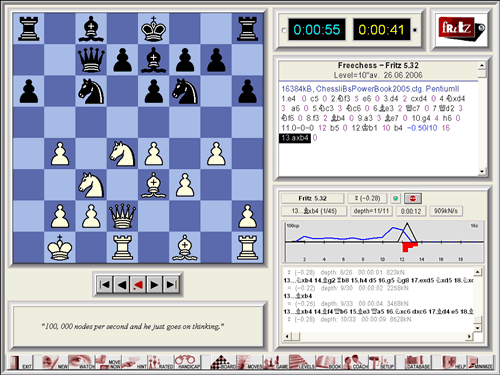
Serious trials based on automata, such as, were too complex and limited to be useful. Since the advent of the in the 1950s, chess enthusiasts, and computer scientists have built, with increasing degrees of seriousness and success, chess-playing machines and computer programs. The groundbreaking paper on computer chess, 'Programming a Computer for Playing Chess', was published in 1950 by Shannon. He wrote: The chess machine is an ideal one to start with, since: (1) the problem is sharply defined both in allowed operations (the moves) and in the ultimate goal (checkmate); (2) it is neither so simple as to be trivial nor too difficult for satisfactory solution; (3) chess is generally considered to require 'thinking' for skillful play; a solution of this problem will force us either to admit the possibility of a mechanized thinking or to further restrict our concept of 'thinking'; (4) the discrete structure of chess fits well into the digital nature of modern computers. 1990s chess-playing computer The (ACM) held the first major chess tournament for computers, the, in September 1970., a chess program from, won the championship. Nowadays, chess programs compete in the, held annually since 1974. At first considered only a curiosity, the best have become extremely strong.
In 1997, a computer won a chess match using classical time controls against a reigning World Champion for the first time: beat 3½–2½ (it scored two wins, one loss, and three ). In 2009, a won a 6 tournament with a performance rating 2898: chess engine 13 running on the mobile phone won the Copa Mercosur tournament with nine wins and one draw.
The best chess programs are now able to consistently beat the strongest human players, to the extent that no longer attract interest from chess players or media. With huge databases of past games and high analytical ability, computers can help players to learn chess and prepare for matches. Allow people to find and play opponents all over the world. The presence of computers and modern communication tools have raised concerns regarding during games, most notably the ' during the 2006 World Championship.
Relation to game theory In 1913, used chess as a basis for his theory of game strategies, which is considered as one of the predecessors of. States that it is possible to, i.e.
To determine with certainty the outcome of a perfectly played game (either white can force a win, or black can force a win, or both sides can force at least a draw). However, according to, there are 10 43 legal positions in chess, so it will take an impossibly long time to compute a perfect strategy with any feasible technology. The 11-category, game theoretical taxonomy of chess includes: two player, no-chance, combinatorial, Markov state (present state is all a player needs to move; although past state led up to that point, knowledge of the sequence of past moves is not required to make the next move, except to take into account of en passant and castling, which do depend on the past moves), zero sum, symmetric, perfect information, non-cooperative, discrete, extensive form (tree decisions, not payoff matrices), sequential.
Computational complexity Generalized chess (played on n × n board, without the ) is. Combinatorial game theory Some applications of to chess endgames were found by (1996). A children's chess tournament in the United States There is an extensive scientific literature on chess psychology.
And others showed that and verbal, rather than visuospatial, ability lies at the core of expertise. In his doctoral thesis, showed that chess masters can rapidly perceive the key features of a position. According to de Groot, this, made possible by years of practice and study, is more important than the sheer ability to anticipate moves. De Groot showed that chess masters can memorize positions shown for a few seconds almost perfectly. The ability to memorize does not alone account for chess-playing skill, since masters and novices, when faced with random arrangements of chess pieces, had equivalent recall (about half a dozen positions in each case). Rather, it is the ability to recognize patterns, which are then memorized, which distinguished the skilled players from the novices.
When the positions of the pieces were taken from an actual game, the masters had almost total positional recall. More recent research has focused on; the respective roles of knowledge and look-ahead search; studies of chess masters and novices;; the role of and in chess skill; gender differences; and computational models of chess expertise.
The role of practice and talent in the development of chess and other domains of expertise has led to much recent research. Ericsson and colleagues have argued that deliberate practice is sufficient for reaching high levels of expertise in chess. Recent research indicates that factors other than practice are also important. For example, and colleagues have shown that stronger players started playing chess at a young age and that experts born in the Northern Hemisphere are more likely to have been born in late winter and early spring.
Compared to general population, chess players are more likely to be non-right-handed, though they found no correlation between handedness and skill. Chess and intelligence Although the link between performance in chess and is often assumed, researchers have largely failed to confirm its existence. For example, a 2006 study found no differences in fluid intelligence, as measured by, between strong adult chess players and regular people. There is some evidence towards a correlation between performance in chess and intelligence among beginning players. However, performance in chess also relies substantially on one's experience playing the game, and the role of experience may overwhelm the role of intelligence.
Chess experts are estimated to have in excess of 10,000 and possibly as many as 300,000 position patterns stored in their memory; long training is necessary to acquire that amount of data. A 2007 study of young chess players in the United Kingdom found that strong players tended to have above-average IQ scores, but, within that group, the correlation between chess skill and IQ was moderately negative, meaning that smarter children tended to achieve a lower level of chess skill.
This result was explained by a negative correlation between intelligence and practice in the elite subsample, and by practice having a higher influence on chess skill. Three bishops per side are the norm for hexagonal variants. There are more than two thousand published chess variants, most of them of relatively recent origin, including: • Direct predecessors of chess such as and. • Traditional national or regional games that share common ancestors with Western chess such as,,,, and. • Modern variations employing different rules (e.g. ), different forces (e.g. ), or different board geometries (e.g.
One rules variant that has gained significantly in popularity is (named 'Fischerandom' by its inventor), where the starting position is, rendering the use of impracticable. FIDE has added Chess960 to its Handbook. •, which has drawn the attention of mathematicians. In the context of chess variants, regular (i.e. FIDE) chess is sometimes referred to as Western chess, international chess, orthodox chess, and orthochess.
Controversy in religion In 2016 in, issued a religious declaring that chess is banned for Muslims. He stated that 'chess is a waste of time and an opportunity to squander money.
It causes enmity and hatred between people'. However, this fatwa is not legally binding and chess remains a popular game in Muslim countries. See also Reference aids • (subject-wide table of contents) • • Lists • • • • •.
Deep Blue, at the Deep Blue was a developed. It is known for being the first computer chess-playing system to win both a chess game and a chess match against a reigning world champion under regular time controls. Deep Blue won its first game against a world champion on 10 February 1996, when it defeated in of a six-game match.
However, won three and drew two of the following five games, defeating Deep Blue by a score of 4–2. Deep Blue was then heavily upgraded, and played Kasparov again in May 1997. Deep Blue won, therefore winning the six-game rematch 3½–2½ and becoming the first computer system to defeat a reigning world champion in a match under standard chess tournament time controls. Kasparov accused IBM of and demanded a rematch.
IBM refused and retired Deep Blue. Development for Deep Blue began in 1985 with the project. This project eventually evolved into, at which point the development team was hired by IBM.
The project evolved once more with the new name Deep Blue in 1989. Grandmaster was also part of the development team. Contents • • • • • • • Origins [ ] The project was started as at by, followed by its successor,. After their graduation from Carnegie Mellon, Hsu,, and from the Deep Thought team were hired by to continue their quest to build a chess machine that could defeat the world champion. Hsu and Campbell joined IBM in autumn 1989, with Anantharaman following later.
Anantharaman subsequently left IBM for Wall Street and Arthur Joseph Hoane joined the team to perform programming tasks. Jerry Brody, a long-time employee of IBM Research, was recruited for the team in 1990. The team was managed first by Randy Moulic, followed by Chung-Jen (C J) Tan. After Deep Thought's 1989 match against Kasparov, IBM held a contest to rename the chess machine and it became 'Deep Blue', a play on IBM's nickname, 'Big Blue'. After a scaled-down version of Deep Blue, Deep Blue Jr., played Grandmaster, Hsu and Campbell decided that Benjamin was the expert they were looking for to develop Deep Blue's, and Benjamin was signed by IBM Research to assist with the preparations for Deep Blue's matches against Garry Kasparov.
In 1995 'Deep Blue prototype' (actually II, renamed for PR reasons) played in the 8th. Deep Blue prototype played the computer program to a draw while Wchess was running on a. In round 5 Deep Blue prototype had the and lost to the computer program 3 in 39 moves while Fritz was running on an Intel 90 personal computer.
In the end of the championship Deep Blue prototype was tied for second place with the computer program Junior while Junior was running on a personal computer. Deep Blue versus Kasparov [ ].
Main article: Deep Blue and Kasparov played each other on two occasions. The first match began on 10 February 1996, in which Deep Blue became the first machine to win () under regular time controls. However, Kasparov won three and drew two of the following five games, beating Deep Blue by a score of 4–2 (wins count 1 point, draws count ½ point). The match concluded on 17 February 1996. Deep Blue was then heavily upgraded (unofficially nicknamed 'Deeper Blue') and played Kasparov again in May 1997, winning the six-game rematch 3½–2½, ending on 11 May. Deep Blue won the deciding after Kasparov made a mistake in the opening, becoming the first computer system to defeat a reigning world champion in a match under standard chess tournament time controls. The system derived its playing strength mainly from computing power.
It was a, -based system with 30 nodes, with each node containing a 120 MHz, enhanced with 480 special purpose chess chips. Its chess playing program was written in and ran under the.
It was capable of evaluating 200 million positions per second, twice as fast as the 1996 version. In June 1997, Deep Blue was the 259th most powerful according to the list, achieving 11.38 on the High-Performance benchmark. The Deep Blue chess computer that defeated in 1997 would typically search to a depth of between six and eight moves to a maximum of twenty or even more moves in some situations.
And estimate that one additional (half-move) increases the playing strength 50 to 70 points. Deep Blue's was initially written in a generalized form, with many to-be-determined parameters (e.g. How important is a safe king position compared to a space advantage in the center, etc.). The optimal values for these parameters were then determined by the system itself, by analyzing thousands of master games. The evaluation function had been split into 8,000 parts, many of them designed for special positions.
In the opening book there were over 4,000 positions and 700,000 games. The endgame database contained many six piece endgames and five or fewer piece positions. Before the second match, the chess knowledge of the program was fine tuned by grandmaster. The opening library was provided by grandmasters,, and. When Kasparov requested that he be allowed to study other games that Deep Blue had played so as to better understand his opponent, IBM refused.
However, Kasparov did study many popular PC games to become familiar with computer game play in general. [ ] Writer suggests that a in Deep Blue's software led to a seemingly random move (the 44th in the first game) which Kasparov misattributed to 'superior intelligence'. Subsequently, Kasparov experienced a drop in performance due to anxiety in the following game.
Aftermath [ ] After the loss, Kasparov said that he sometimes saw deep intelligence and creativity in the machine's moves, suggesting that during the second game, human chess players had intervened on behalf of the machine, which would be a violation of the rules. IBM denied that it cheated, saying the only human intervention occurred between games. The rules provided for the developers to modify the program between games, an opportunity they said they used to shore up weaknesses in the computer's play that were revealed during the course of the match.
Kasparov requested printouts of the machine's log files but IBM refused, although the company later published the logs on the Internet. Kasparov demanded a rematch, but IBM refused and dismantled Deep Blue.
Owing to an insufficient sample of games between Deep Blue and officially rated chess players, a chess rating for Deep Blue was not established. [ ] In 2003 a was made that explored these claims. Entitled, the film interviewed some people who suggest that Deep Blue's victory was a ploy by IBM to boost its stock value. One of the cultural impacts of Deep Blue was the creation of a new game called designed to be much more difficult for computers than chess.
One of the two racks that made up Deep Blue is on display at the in their exhibit about the; [ ] the other rack appears at the in the 'Artificial Intelligence and Robotics' gallery of the Revolution exhibit. Reports that Deep Blue was sold to appear to originate from confusion between Deep Blue itself and other RS6000/SP2 systems. Later claimed in his book Behind Deep Blue that he had the rights to use the Deep Blue design to build a bigger machine independently of IBM to take Kasparov's rematch offer, but Kasparov refused a rematch. Deep Blue, with its capability of evaluating 200 million positions per second, was the fastest computer to face a world chess champion. Today, in computer chess research and matches of world class players against computers, the focus of play has often shifted to software, rather than using dedicated chess hardware. Modern chess programs like,, or are more efficient than the programs during Deep Blue's era.
In a November 2006 match between Deep Fritz and world chess champion, the program ran on a computer system containing a dual-core, capable of evaluating only 8 million positions per second, but searching to an average depth of 17 to 18 plies in the thanks to; it won 4–2. See also [ ]. NY Daily News. Retrieved 2017-08-03. • (11 May 2007)... From the original on 13 May 2007. • Hsu 2002, p.265 •.
Retrieved 2017-08-03. • Hsu 2002, pp.92–95 • Hsu 2002, p.107 • Hsu 2002, p.132 • IBM..
IBM Research. From the original on 12 December 2008. Retrieved 19 August 2008. • Hsu 2002, p.136 • Hsu 2002, pp.126–127 • Hsu 2002, pp.160–161, 174, 177, 193 • 7 October 2008 at the. • 19 October 2007 at the., Deep Blue • 13 February 2009 at the.
Top500.org • Campbell 1998, p. • Levy & Newborn 1991, p. 192 • Weber, Bruce (1997-05-18).. The New York Times.. Retrieved 2017-07-04. • Roberts, Jacob (2016)..
2 (2): 14-23. From the original on 17 February 2017. Retrieved 17 February 2017. • ^ Plumer, Brad (26 September 2012).. From the original on 9 November 2012.
Retrieved 5 January 2014. • • ^ 12 October 2007 at the., by Mark Weeks,, June 2005 • 30 March 2014 at the.
• 3 July 2013 at the. Collections database. Retrieved 10 January 2014. 7 December 1997. From the original on 11 May 2013. The Week In Chess. 13 January 2000.
From the original on 29 July 2012. Retrieved 11 May 2012 •.
English translation of Spiegel Article. 23 November 2006. From the original on 16 October 2012. 5 December 2006. From the original on 31 December 2007. Retrieved 4 May 2008.
Bibliography • (2002). 'Behind Deep Blue: Building the Computer that Defeated the World Chess Champion'... •; Newborn, Monty (1991). 'How Computers Play Chess'. Computer Science Press..
'An Enjoyable Game'. HAL's Legacy: 2001's Computer as Dream and Reality.
Cambridge, Mass.: MIT Press. • Syed, Omar; Syed, Aamir (2003). 'Arimaa – a New Game Designed to be Difficult for Computers'. International Computer Games Association Journal 26: 138–139 Further reading [ ] • Newborn, Monty (1997). 'Kasparov versus Deep Blue: Computer Chess Comes of Age'...
Deeper Blue: The Ultimate Man v. Machine Challenge'... • Newborn, Monty (2002). • Campbell, M.; Hoane, A. Artificial Intelligence. External links [ ] • player profile and games at •, IBM Research pages on Deep Blue •, IBM page with the computer logs from the games •, Open letter from Feng-hsiung Hsu on the aborted rematch with Kasparov, Magazine, issue 270, 10 January 2000 •, Open Letter from Owen Williams (Gary Kasparov's manager), responding to Feng-hsiung Hsu, 13 January 2000 •, Deep Blue system described by Feng-hsiung Hsu, Murray Campbell and A. Joseph Hoane Jr.
•, ICC Interview with Feng-Hsiung Hsu, an online interview with Hsu in 2002 (annotated).