Download 2014 990 Ez
Overview of Form 990-EZ. The Form 990-EZ is an annual information return required to be filed with the IRS by many organizations exempt from income tax under section 501(a), and certain political organizations and nonexempt charitable trusts. Parts I through V of the form must be completed by all filing organizations (Part VI must be completed by section 501(c)(3) organizations and section 4947(a)(1) nonexempt charitable trusts), and require reporting on the organization's exempt and other activities, finances, compliance with certain federal tax filings and requirements, and compensation paid to certain persons. Additional schedules are required to be completed depending on the activities and type of organization. The completed Form 990-EZ filed with the IRS, except for certain contributor information on Schedule B (Form 990, 990-EZ, or 990-PF), is required to be made available to the public by the IRS and the filing organization (see Appendix D).
Also, the organization may be required to file the completed Form 990-EZ with state governments to satisfy state reporting requirements. See Appendix G, Use of Form 990 and 990-EZ To Satisfy State Reporting Requirements. • Throughout these instructions, 'the organization' and the 'filing organization' both refer to the organization filing the Form 990-EZ. • The examples appearing throughout these instructions are illustrative only and for the purpose of completing Form 990-EZ, but aren’t all-inclusive. • Instructions for the Form 990-EZ schedules are published separately from these instructions. • Unless otherwise specified, information should be provided for the organization’s tax year.
For instance, an organization should answer 'Yes' to a question asking whether it conducted a certain type of activity only if it conducted that activity during the tax year. Who Must File Most organizations exempt from income tax under section 501(a) must file an annual information return (Form 990 or 990-EZ) or submit an annual electronic notice (Form 990-N, Electronic Notice (e-Postcard) for Tax-Exempt Organizations Not Required to File Form 990 or Form 990-EZ), depending upon the organization's gross receipts and total assets. If an organization has gross receipts less than $200,000 and total assets at the end of the year less than $500,000, it can file Form 990-EZ, instead of Form 990.
The Form 990 provides the public with financial information about a nonprofit organization, and is often the only source of such information. It is also used. Search the world's information, including webpages, images, videos and more. Google has many special features to help you find exactly what you're looking for.
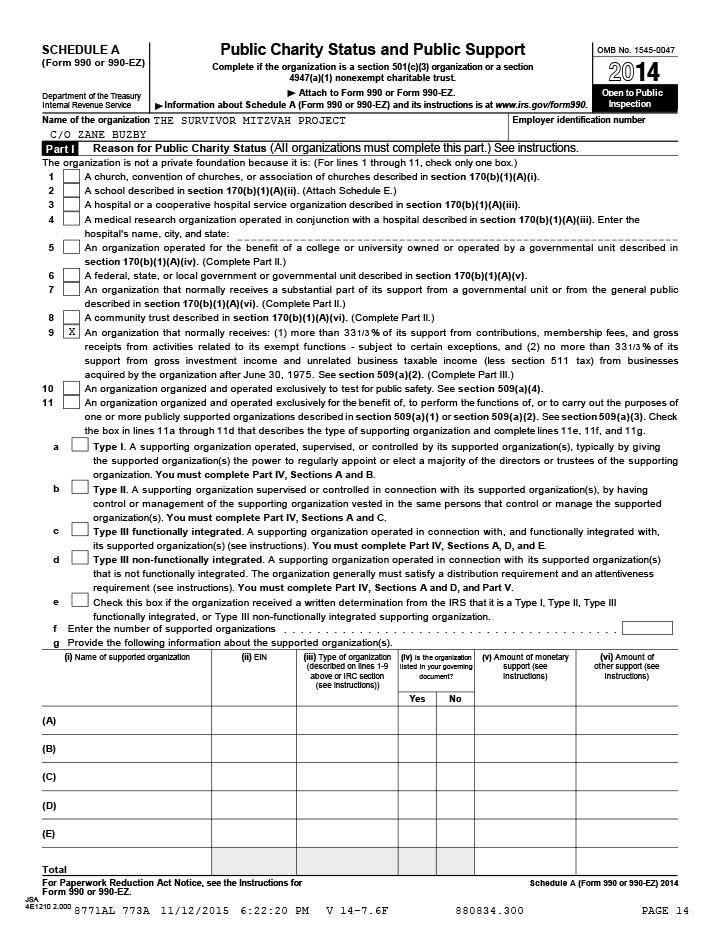
But see the special rules later for Sponsoring organizations of donor advised funds, Organizations that operate one or more hospital facilities, Section 501(c)(29) nonprofit health insurance issuers, and Controlling organizations described in section 512(b)(13). Form 990 (not 990-EZ or 990-N) must be filed by an organization exempt from income tax under section 501(a) (including an organization that hasn’t applied for recognition of exemption or whose application for recognition of exemption is pending) if it has either gross receipts greater than or equal to $200,000 or total assets greater than or equal to $500,000 at the end of the tax year (with exceptions described below for organizations eligible to submit Form 990-N and for certain organizations described in General Instruction B, Organizations Not Required To File Form 990 or 990-EZ, later).
Organizations that must file include the following. Gross receipts. Gross receipts are the total amounts the organization received from all sources during its annual accounting period, without subtracting any costs or expenses. See Appendix B, How To Determine Whether an Organization's Gross Receipts Are Normally $50,000 (or $5,000) or Less for a discussion of gross receipts.
Total assets is the amount reported by the organization on its balance sheet (Form 990-EZ, Part II, column (B), line 25) as of the end of the year, without reduction for liabilities. For purposes of Form 990 or Form 990-EZ reporting, the term 'section 501(c)(3)' includes organizations exempt under sections 501(e) and (f) (cooperative service organizations), 501(j) (amateur sports organizations), 501(k) (child care organizations), and 501(n) (charitable risk pools). In addition, any organization described in one of these sections is also subject to section 4958 if it obtains a determination letter from the IRS stating that it is described in section 501(c)(3). If an organization normally has annual gross receipts of $50,000 or less, it must submit Form 990-N if it doesn’t file Form 990 or Form 990-EZ (with exceptions described later for certain section 509(a)(3) supporting organizations and for certain organizations described in General Instruction B). If the organization chooses to file Form 990-EZ, be sure to file a complete return.
See Appendix B for a discussion of gross receipts and General Instruction H, Requirements for a Properly Completed Form 990-EZ for a discussion of a complete return. Section 4947(a)(1) nonexempt charitable trusts. A nonexempt charitable trust described under section 4947(a)(1) (if it isn’t treated as a private foundation) is required to file Form 990 or Form 990-EZ unless excepted under General Instruction B.
Such a trust is treated like an exempt section 501(c)(3) organization for purposes of completing the form. Section 4947(a)(1) trusts must complete all sections of the Form 990-EZ and schedules that 501(c)(3) organizations must complete. All references to a section 501(c)(3) organization in the Form 990-EZ, schedules, and instructions include a section 4947(a)(1) trust (for instance, such a trust must complete Schedule A (Form 990 or 990-EZ)), unless otherwise specified. If such a trust doesn’t have any taxable income under Subtitle A of the Code, it can file Form 990 or Form 990-EZ to meet its section 6012 filing requirement and doesn’t have to file Form 1041, U.S. Income Tax Return for Estates and Trusts. Returns when exempt status not established.
An organization is required to file Form 990 or 990-EZ in accordance with these instructions if the organization claims exempt status under section 501(a) but hasn’t established such exempt status by filing Form 1023, Application for Recognition of Exemption Under Section 501(c)(3) of the Internal Revenue Code; Form 1023-EZ, Streamlined Application for Recognition of Exemption Under Section 501(c)(3) of the Internal Revenue Code; or Form 1024, Application for Recognition of Exemption Under Section 501(a), and receiving an IRS determination letter recognizing exempt status. In such cases, the organization must check the 'application pending' checkbox in Item B of the Form 990 or 990-EZ header (whether or not a Form 1023, 1023-EZ, or 1024 has been filed) to indicate that the Form 990 or 990-EZ is being filed in the belief that the organization is exempt under section 501(a). To qualify for tax exemption retroactive to its date of organization or formation, an organization claiming tax-exempt status under section 501(c)(3), 501(c)(9), or 501(c)(17) generally must file Form 1023, 1023-EZ, or 1024 within 27 months of the end of the month in which it was legally organized or formed.
Organizations Not Required To File Form 990 or 990-EZ An organization described below doesn’t have to file Form 990 or 990-EZ even if it has at least $200,000 of gross receipts or $500,000 total assets at the end of the tax year (except for section 509(a)(3) supporting organizations described in General Instruction A). See General Instruction A for determining whether the organization can file Form 990-EZ instead of Form 990. An organization described in item 10 or 11 under Certain organizations with limited gross receipts, or item 13 under Certain organizations that file different kinds of annual information returns, is required to submit Form 990-N unless it voluntarily files Form 990, 990-EZ, or 990-BL, Information and Initial Excise Tax Return for Black Lung Benefit Trusts and Certain Related Persons, as applicable.
Certain religious organizations. • A church, an interchurch organization of local units of a church, a convention or association of churches, or an integrated auxiliary of a church as described in Regulations section 1.6033-2(h) (such as a men's or women's organization, religious school, mission society, or youth group).
• A church-affiliated organization that is exclusively engaged in managing funds or maintaining retirement programs and is described in Rev. But see the filing requirements for section 509(a)(3) supporting organizations in General Instruction A. • A school below college level affiliated with a church or operated by a religious order, as described in Regulations section 1.6033-2(g)(1)(vii). • A mission society sponsored by, or affiliated with, one or more churches or church denominations, if more than half of the society's activities are conducted in, or directed at, persons in foreign countries. • An exclusively religious activity of any religious order described in Rev.
91-20, 1991-1 C.B. Certain governmental organizations • A state institution whose income is excluded from gross income under section 115. • A governmental unit or affiliate of a governmental unit described in Rev. But see the filing requirements for section 509(a)(3) supporting organizations in General Instruction A. • An organization described in section 501(c)(1). A section 501(c)(1) organization is a corporation organized under an act of Congress that is an instrumentality of the United States, and exempt from federal income taxes.
Certain political organizations • A political organization that is. • A state or local committee of a political party, • A political committee of a state or local candidate, • A caucus or association of state or local officials, or • Required to report under the Federal Election Campaign Act of 1971 as a political committee (as defined in section 301(4) of such Act). Certain organizations with limited gross receipts • An organization whose gross receipts are normally $50,000 or less. Such organizations generally are required to submit Form 990-N if they choose not to file Form 990 or 990-EZ. To determine what an organization's gross receipts 'normally' are, see Appendix B. • Foreign organizations and organizations located in U.S.
Possessions, whose gross receipts from sources within the United States are normally $50,000 or less, and which didn’t engage in significant activity in the United States (other than investment activity). Such organizations, if they claim U.S. Tax exemption or are recognized by the IRS as tax exempt, generally are required to submit Form 990-N if they choose not to file Form 990 or 990-EZ. If a foreign organization or organization located in a U.S. Possession is required to file a Form 990 or Form 990-EZ, then its worldwide gross receipts, as well as assets, are taken into account in determining whether it qualifies to file Form 990-EZ. To determine what an organization's gross receipts normally are, see Appendix B. Certain organizations that file different kinds of annual information returns • A private foundation (including a private operating foundation) exempt under section 501(c)(3) and described in section 509(a).
Use Form 990-PF for a taxable private foundation, a section 4947(a)(1) nonexempt charitable trust treated as a private foundation, and a private foundation terminating its status by becoming a public charity under section 507(b)(1)(B) for tax years within its 60-month termination period. If the section 507(b)(1)(B) organization successfully terminates, then it files Form 990 or 990-EZ in its final year of termination. • A black lung benefit trust described in section 501(c)(21), use Form 990-BL.
• A religious or apostolic organization described in section 501(d). Use Form 1065, U.S. Return of Partnership Income. • A stock bonus, pension, or profit-sharing trust that qualifies under section 401. Use Form 5500, Annual Return/Report of Employee Benefit Plan. Short period.
A short accounting period is a period of less than 12 months, which exists when an organization first commences operations, changes its accounting period, or terminates. If the organization's short year began in 2016 and ended before December 31, 2016 (not on or after December 31, 2016), it may use either 2015 Form 990-EZ or 2016 Form 990-EZ or Form 990 to file for such short year. The 2016 form may also be used for a short period beginning in 2017 and ending before December 31, 2017 (not on or after December 31, 2017). When doing so, provide the information for designated years listed on the return, other than the tax year being reported, as if they were updated on the 2017 form. For example, provide the information in Schedule A, Part II for the tax years 2013–2017, rather than for tax years 2012–2016. A short-period return can’t be filed electronically unless it is an initial return for which the 'Initial return' box is checked or is a final return for which the 'Final return/terminated' box is checked in Item B of the Form 990-EZ heading.
Accounting period change. If the organization changes its accounting period, it must file a Form 990-EZ for the short period resulting from the change.
Enter 'Change of Accounting Period' at the top of this short-period return. If the organization has previously changed its annual accounting period at any time within the 10-calendar-year period that includes the beginning of the short period resulting from the current change in accounting period, and it had a Form 990 series or income tax return filing requirement at any time during that 10-year period, it must also file a Form 1128, Application To Adopt, Change, or Retain a Tax Year, with the short-period return. 85-58, 1985-2 C.B. If an organization that submits Form 990-N changes its accounting period, it must report this change either on Form 990, 990-EZ, or 1128, or by sending a letter to: Internal Revenue Service 1973 Rulon White Blvd. Ogden, UT 84201. Accounting method change. Generally, the organization must file Form 3115, Application for Change in Accounting Method, to change its accounting method.
An exception applies where a section 501(c) organization changes its accounting method to comply with Statement of Financial Accounting Standards, No. 116 (SFAS 116) (ASC 958), Accounting for Contributions Received and Contributions Made. See Notice 96-30, 1996-1 C.B. An organization that makes a change in accounting method, regardless of whether it files Form 3115, must report any adjustment required by section 481(a) on Form 990-EZ, line 20 (other changes in net assets or fund balances), as a net asset adjustment made during the tax year. The organization must explain in Schedule O (Form 990 or 990-EZ), Supplemental Information to Form 990 or 990-EZ, the change and net asset adjustment.
The adjustment must be identified as the effect of changing to the method provided in SFAS 116 (ASC 958). The beginning of year statement of financial position (balance sheet) shouldn’t be restated to reflect any prior period adjustments. When, Where, and How To File File Form 990-EZ by the 15th day of the 5th month after the organization's accounting period ends (May 15 for a calendar-year filer). If the due date falls on a Saturday, Sunday, or legal holiday, file on the next business day.
A business day is any day that isn’t a Saturday, Sunday, or legal holiday. If the organization is liquidated, dissolved, or terminated, file the return by the 15th day of the 5th month after liquidation, dissolution, or termination. If the return isn’t filed by the due date (including any extension granted), attach a statement giving the reason(s) for not filing on time.
Send the return to the: Department of the Treasury Internal Revenue Service Center Ogden, UT. • DHL Express 9:00, DHL Express 10:30, DHL Express 12:00, DHL Express Worldwide, DHL Express Envelope, DHL Import Express 10:30, DHL Import Express 12:00, and DHL Import Express Worldwide. • Federal Express (FedEx): FedEx First Overnight, FedEx Priority Overnight, FedEx Standard Overnight, FedEx 2Day, FedEx International Priority, FedEx International First, FedEx International Next Flight Out, and FedEx International Economy. • United Parcel Service (UPS): UPS Next Day Air, UPS Next Day Air Saver, UPS Next Day Air Early AM, UPS 2nd Day Air, UPS 2nd Day Air AM, UPS Worldwide Express Plus, and UPS Worldwide Express.
The private delivery service can tell you how to get written proof of the mailing date. • For private delivery services, deliver the return to: Internal Revenue Service 1973 Rulon White Blvd. Ogden, UT 84201. Electronic filing. The organization can file Form 990-EZ or Form 990 and related forms, schedules, and attachments electronically. However, if an organization files at least 250 returns of any type during the calendar year ending with or within the organization's tax year and has total assets of $10 million or more at the end of the tax year, it must file Form 990 electronically (and not Form 990-EZ). 'Returns' for this purpose include information returns (for example, Forms W-2, Wage and Tax Statement; Forms 1099), income tax returns, employment tax returns (including quarterly Form 941, Employer's QUARTERLY Federal Tax Return), and excise tax returns.
If an organization is required to file a return electronically but doesn’t, the organization is considered not to have filed its return, even if a paper return is submitted, unless it is reporting a name change, in which case it must file by paper and attach the documents described in Specific Instructions, Item B. See Regulations section 301.6033-4 for more information on required electronic filing of Form 990. For additional information on the electronic filing requirement, visit. The IRS may waive the requirements to file electronically in cases of undue hardship. For information on filing a waiver, see Notice 2010-13, 2010-4 I.R.B. 327, available.
Amended Return/Final Return To amend the organization's return for any year, file a new return including any required schedules. Use the version of Form 990-EZ applicable to the year being amended. The amended return must provide all the information called for by the form and instructions, not just the new or corrected information. Check the 'Amended return' box in Item B of the heading of the return. Also, list in Schedule O (Form 990 or 990-EZ) which parts and schedules of the Form 990-EZ were amended and describe the amendments. The organization can file an amended return at any time to change or add to the information reported on a previously filed return for the same period.
It must make the amended return available for inspection for 3 years from the date of filing or 3 years from the date the original return was due, whichever is later. If the organization needs a copy of its previously filed return, it can file Form 4506-A, Request for Public Inspection or Copy of Exempt or Political Organization IRS Form. See IRS.gov for information on getting blank tax forms. If the return is a final return, the organization must check the 'Final return/terminated' box in Item B of the heading of the return and complete Schedule N (Form 990 or 990-EZ), Liquidation, Termination, Dissolution, or Significant Disposition of Assets. Against the organization. Under section 6652(c)(1)(A), a penalty of $20 a day, not to exceed the lesser of $10,000 or 5% of the gross receipts of the organization for the year, can be charged when a return is filed late, unless the organization can show that the late filing was due to reasonable cause. Organizations with annual gross receipts exceeding $1,020,000 are subject to a penalty of $100 for each day failure continues (with a maximum penalty for any one return of $51,000).
The penalty applies on each day after the due date that the return isn’t filed. Tax-exempt organizations which are required to file electronically but don’t are deemed to have failed to file the return. This is true even if a paper return is submitted, unless the organization files by paper to report a name change. The penalty can also be charged if the organization files an incomplete return, such as by failing to complete a required line item or a required part of a schedule.
To avoid penalties and having to supply missing information later. • Complete all applicable line items; • Unless instructed to skip a line, answer each question on the return; • Make an entry (including a zero when appropriate) on all lines requiring an amount or other information to be reported; and • Provide required explanations as instructed.
Also, this penalty can be imposed if the organization's return contains incorrect information. For example, an organization that reports contributions net of related fundraising expenses may be subject to this penalty. Use of a paid preparer doesn’t relieve the organization of its responsibility to file a complete and accurate return. Against responsible person(s). If the organization doesn’t file a complete return or doesn’t furnish correct information, the IRS will send the organization a letter that includes a fixed time to fulfill these requirements.
After that period expires, the person failing to comply will be charged a penalty of $10 a day. The maximum penalty on all persons for failures for any one return shall not exceed $5,000. There are also penalties (fines and imprisonment) for willfully not filing returns and for filing fraudulent returns and statements with the IRS (sections 7203, 7206, and 7207). States can impose additional penalties for failure to meet their separate filing requirements. Automatic revocation for nonfiling for three consecutive years.
The law requires most tax-exempt organizations, other than churches, to file an annual Form 990, 990-EZ, or 990-PF with the IRS, or to submit a Form 990-N to the IRS. If an organization fails to file an annual return or submit an annual notice as required for 3 consecutive years, its tax-exempt status is automatically revoked on and after the due date for filing its third annual return or notice. Organizations that lose their exemption may need to file income tax returns and pay income tax, but may apply for reinstatement of exemption. For details, go to. The organization's records should be kept as long as they can be needed for the administration of any provision of the Internal Revenue Code.
Usually, records that support an item of income, deduction, or credit must be kept a minimum of 3 years from the date the return is due or filed, whichever is later. Keep records that verify the organization's basis in property as long as they are needed to figure the basis of the original or replacement property. Applicable law and an organization's policies can require that the organization retain records longer than 3 years.
The organization should also keep copies of any returns it has filed. They help in preparing future returns and making computations when filing an amended return. Completing all lines. Make an entry (including a -0- when appropriate) on all lines requiring an amount or other information to be reported. Do not leave any applicable lines blank, unless expressly instructed to skip that line. If answering a line is predicated on a 'Yes' answer to the preceding line, and if the organization's answer to the preceding line was 'No,' then leave the 'If Yes' line blank.
In general, answers can be explained or supplemented in Schedule O if the allotted space in the form or other schedule is insufficient, or if a 'Yes' or 'No' answer is required but the organization wishes to explain its answer. Missing or incomplete parts of the form and/or required schedules may result in the IRS contacting you to obtain the missing information. Failure to supply the information may result in a penalty being assessed to your account.
For tips on filing complete returns, go to. Reporting proper amounts.
Some lines request information reported on other forms filed by the organization, such as Forms W-2, 1099, and 990-T. If the organization is aware that the amount actually reported on the other form is incorrect, it must report on Form 990-EZ the information that should have been reported on the other form (in addition to filing an amended form with the proper amount). In general, don’t report negative numbers, but report -0- in lieu of a negative number, unless the instructions provide otherwise. Report revenue and expenses separately and don’t net related items, unless otherwise provided. Inclusion of activities and items of disregarded entities and joint ventures. An organization must report in its Form 990-EZ all of the revenues, expenses, assets, liabilities, and net assets or funds of a disregarded entity of which it is the sole member, and must report in its Form 990-EZ its share of all such items of a joint venture or other investment or arrangement treated as a partnership for federal income tax purposes.
This includes passive investments. In addition, the organization generally must report the activities of a disregarded entity or a joint venture as its own activities in the appropriate parts and schedules of the Form 990-EZ.
• Schedule A, Public Charity Status and Public Support. See Part V, Other Information. • Schedule B, Schedule of Contributors. See General Instruction H, Requirements for a Properly Completed Form 990-EZ, earlier. • Schedule C, Political Campaign and Lobbying Activities, Part III. See Line 35c (section 6033(e) notice and proxy tax requirements). • Schedule C, Part I.
See Line 46 (political campaign activities). • Schedule C, Part II. See Line 47 (lobbying activities). • Schedule E, Schools. See Line 48 (schools).
• Schedule G, Supplemental Information Regarding Fundraising or Gaming Activities, Parts II and III. See Lines 6a through 6d (gaming and fundraising events).
• Schedule L, Transactions With Interested Persons, Part I. See Line 40b (section 4958 excess benefit transactions). • Schedule L, Part II. See Line 38 (loans to or from officers, directors, trustees, and key employees). • Schedule N, Liquidation, Termination, Dissolution, or Significant Disposition of Assets, Parts I (liquidation, termination, or dissolution) and II (significant disposition of net assets). See Line 36 (liquidation, dissolution, termination, or significant disposition of net assets). • Schedule O, Supplemental Information to Form 990 or Form 990-EZ.
See Lines 8, 10, 16, 20, 24, 26, 31, 33, 34, 35, and 44. • Core form with all parts completed (Parts I–V, Part VI by section 501(c)(3) organizations, Signature Block). • Schedules A, B, C, E, G, L, N, and/or O, completed as applicable, filed in alphabetical order. • Attachments, completed as applicable. These include (a) name change amendment to organizing document required by Item B of the heading on page 1 of the return; (b) reasonable cause explanation for a late-filed return; and (c) articles of merger or dissolution, resolutions, and plans of liquidation or merger required by Schedule N (Form 990 or 990-EZ). Do not attach materials not authorized in the instructions, or not otherwise authorized by the IRS.
IF the organization is: THEN attach: A corporation A copy of the amendment to the articles of incorporation, and proof of filing with the appropriate state authority. A trust A copy of the amendment to the trust instrument, or a resolution to amend the trust instrument, showing the effective date of the change of name and signed by at least one trustee. An unincorporated association A copy of the amendment to the articles of association, constitution, or other organizing document, showing the effective date of the change of name and signed by at least two officers, trustees, or members. Final return/terminated. Check this box if the organization has terminated its existence or ceased to be a section 501(a) or section 527 organization and is filing its final return as an exempt organization or section 4947(a)(1) trust. See the instructions for line 36 that discuss liquidations, dissolutions, terminations, or significant disposition of net assets. An organization that checks this box because it has liquidated, terminated, ceased operations, dissolved, merged into another organization, or has had its exemption revoked during the tax year must also attach Schedule N (Form 990 or 990-EZ).
Application pending. Check this box if the organization either has filed a Form 1023, 1023-EZ, or 1024 with the IRS and is awaiting a response, or claims tax-exempt status under section 501(a) but hasn’t filed Form 1023, 1023-EZ, or 1024 to be recognized as tax exempt by the IRS. If this box is checked, the organization must complete all parts of the Form 990-EZ and any required schedules. An organization that is required to file an annual information return (Form 990 or 990-EZ) or submit an annual electronic notice (Form 990-N) for a given tax year (see General Instruction A) must do so even if it hasn’t filed a Form 1023, 1023-EZ, or 1024 with the IRS, if it claims tax-exempt status.
To qualify for tax exemption retroactive to the date of its organization or formation, an organization claiming tax-exempt status under section 501(c)(3), 501(c)(9), or 501(c)(17) generally must file Form 1023, 1023-EZ, or 1024 within 27 months of the end of the month in which it was legally organized or formed. Name and Address Enter the organization's legal name in the 'Name of organization' box. If the organization operates under a name different from its legal name, identify its alternate name, after the legal name, by writing 'a.k.a.'
(also known as) and the alternate name of the organization. If multiple a.k.a. Names won’t fit in the box, list them in Schedule O. However, if the organization has changed its legal name, follow the instructions in Item B for reporting the name change. Include the suite, room, or other unit number after the street address. If the Post Office doesn’t deliver mail to the street address and the organization has a P.O. Box, enter the box number instead of the street address.
If the organization receives its mail in care of a third party (such as an accountant or an attorney), enter 'C/O' on the street address line, followed by the third party's name and street address or P.O. For foreign addresses, enter information in the following order: city or town, state or province, the name of the country, and the postal code. Please don’t abbreviate the country name.
If a change of address occurs after the return is filed, use Form 8822-B, Change of Address or Responsible Party — Business, to notify the IRS of the new address. Employer Identification Number (EIN) Use the employer identification number (EIN) provided to the organization for filing its Form 990-EZ and federal tax returns. The organization must have only one EIN.
If the organization has more than one EIN and hasn’t been advised which to use, notify the: Department of the Treasury Internal Revenue Service Center Ogden, UT State what EINs the organization has, the name and address to which each number was assigned, and the address of the organization's principal office. The IRS will advise the organization which number to use. • It is a section 501(c)(3) organization and met the 33 1/3% support test of the regulations under sections 509(a)(1) and 170(b)(1)(A)(vi); checks the box on Schedule A (Form 990 or 990-EZ), Part II, line 13, 16a, or 16b; and received from any one contributor, during the tax year, contributions of the greater of $5,000 (in money or property) or 2% of the amount on Form 990-EZ, Part I, line 1 (contributions, gifts, grants, and similar amounts received). An organization filing Schedule B can limit the contributors it reports on Schedule B using this greater than $5,000 or 2% threshold only if it checks the box on Schedule A (Form 990 or 990-EZ), Part II, line 13, 16a, or 16b. • It is a section 501(c)(3) organization that didn’t meet the 33 1/3% support test of the regulations under sections 509(a)(1) and 170(b)(1)(A)(vi), and received during the tax year contributions of $5,000 or more from any one contributor.
• It is a section 501(c)(7), 501(c)(8), or 501(c)(10) organization that received, during the tax year, (a) contributions of any amount for use exclusively for religious, charitable, scientific, literary, or educational purposes; or (b) contributions of $5,000 or more not exclusively for such purposes from any one contributor. • It isn’t a section 501(c)(3), 501(c)(7), 501(c)(8), or 501(c)(10) organization and it received during the tax year contributions of $5,000 or more from any one contributor. See the instructions to Schedule B for more information. If The organization didn’t receive a contribution of $5,000 or more from any one contributor* (reportable on line 1 of the Form 990-EZ), Then The organization should check the box in Item H to certify that it isn’t required to attach Schedule B. Otherwise Complete and attach Schedule B.
* To determine if the organization received a contribution of $5,000 or more from a contributor during the year, add all direct and indirect gifts, grants, or contributions of $1,000 or more in cash or property that a contributor made to the organization during the year. Do not include smaller gifts, grants, or contributions. See the instructions for Schedule B for more information. Revenue, Expenses, and Changes in Net Assets or Fund Balances All organizations filing Form 990-EZ with the IRS or any state must complete Part I. Some states that accept Form 990-EZ in place of their own forms may require additional information. See Appendix G. Check the box in the heading of Part I if Schedule O (Form 990 or 990-EZ) contains any information pertaining to this part.
Neither Form 5500 nor Department of Labor (DOL) Forms LM-2 or LM-3, Labor Organization Annual Report, should be substituted for the Form 990-EZ, lines 1–17. • Report amounts received as voluntary contributions; for example, payments, or the part of any payment, for which the payer (donor) doesn’t receive fair market value (FMV) from the recipient (donee) organization. Contributions are reported on line 1 regardless of whether they are deductible by the contributor. • Enter the gross amounts of contributions, gifts, grants, and bequests that the organization received from individuals, trusts, corporations, estates, affiliates, foundations, public charities, and other exempt organizations, or raised by an outside professional fundraiser. • Report the value of noncash contributions at the time of the donation. For example, report the gross value of a donated car as of the time the car was received as a donation.
• Report all related expenses on lines 12 through 16. Enter on line 13 professional fundraising fees relating to the gross amounts of contributions collected in the charity's name by fundraisers.
Reporting line 1 amounts in accordance with SFAS 116 (ASC 958) generally is acceptable (though not required) for Form 990 and 990-EZ purposes, but the value of donated services or use of materials, equipment, or facilities may not be reported. However, state law may require it. An organization that receives a grant to be paid in future years should, according to SFAS 116 (ASC 958), report the grant's present value on line 1.
Accruals of present value increments to the unpaid grant should also be reported on line 1 in future years. The organization must report any contributions of conservation easements and other qualified conservation contributions consistently with how it reports revenue from such contributions in its books, records, and financial statements. Report assets contributed to the organization by another entity in the course of the entity’s liquidation, dissolution, or termination. Do not net losses from uncollectible pledges, refunds of contributions and service revenue, or reversal of grant expenses on line 1.
Rather, report any such items as Other changes in net assets or fund balances on Part I, line 20, and explain in Schedule O. Contributions can arise from fundraising events when an excess payment is received for items offered. Fundraising activities relate to soliciting and receiving contributions. However, fundraising activities such as dinners, door-to-door sales of merchandise, carnivals, and bingo games can produce both contributions and revenue.
Report as a contribution, both on line 1 and on line 6b (within the parentheses), any amount received through such a fundraising event that is greater than the FMV (retail value) of the merchandise or services furnished by the organization to the contributor. Report all gross income from gaming activities on line 6a. This situation usually occurs when organizations seek support from the public through solicitation programs that are in part fundraising events or activities and are in part solicitations for contributions.
The primary purpose of such solicitations is to receive contributions and not to sell the merchandise at its retail value, even though this might produce a profit. An organization holds a dinner, charging $400 per person for the meal. The dinner has a retail value of $160. A person who purchases a ticket is really purchasing the dinner for $160 and making a contribution of $240. The contribution of $240, which is the difference between the buyer's payment and the retail value of the dinner, is reported on line 1 and again on line 6b (within the parentheses).
The revenue received ($160 retail value of the dinner) is reported on line 6b. Expenses directly related to the dinner are reported on line 6c. Fundraising expenses relating to the contribution of $240 are reported on lines 12 through 16. If a contributor gives more than $160, that person would be making a contribution of the difference between the dinner's retail value of $160 and the amount actually given. 67-246, 1967-2 C.B. 104, as distinguished from Rev.
74-348 1974-2 C.B. 80, explains this principle in detail. See also the instructions for line 6, and Pub. 526, Charitable Contributions. Contributions can arise from fundraising events when items of only nominal or insubstantial value are given or offered. If an organization offers goods or services of only nominal or insubstantial value through a fundraising event, or distributes free, unordered, low-cost items to patrons, report the entire amount received for such benefits as a contribution on line 1. See also the instruction for Line 6b.
B1, later, regarding nominal or insubstantial value. Report all related expenses on lines 12 through 16. Benefits have a nominal or insubstantial value if the organization informs patrons how much of their payment is a deductible contribution, and either. Grants equivalent to contributions. Grants made to encourage an organization receiving the grant to carry on programs or activities that further the grant recipient's exempt purposes are grants that are equivalent to contributions. Report them on line 1.
The grantor can specify which of the recipient's activities the grant may be used for, such as an adoption program or a disaster relief project. A grant is still equivalent to a contribution if the grant recipient performs a service, or produces a work product, that benefits the grantor incidentally (but see the instruction for Line 1. Contributions or grants from governmental units. Whether a payment from a governmental unit is labeled a 'grant' or a 'contract' doesn’t determine whether the payment should be reported on line 1. Rather, a grant or other payment from a governmental unit is treated as a grant equivalent to a contribution if its primary purpose is to enable the recipient to provide a service to, or maintain a facility for, the direct benefit of the public rather than to serve the direct and immediate needs of the grantor (even if the public pays part of the expense of providing the service or facility). (See the instruction for Line 2.
D, later.) The following are examples of governmental grants and other payments that are treated as contributions and reported on line 1. • Payments by a governmental unit for the construction or maintenance of library or museum facilities open to the public. • Payments by a governmental unit to nursing homes to provide health care to their residents (but not Medicare, Medicaid, and other similar payments on behalf of specific individuals under the line 2 instructions). • Payments by a governmental unit to child placement or child guidance organizations under government programs to better serve children in the community. The following examples illustrate the distinction between government payments reportable on lines 1 and 2.
• A payment by a governmental agency to a medical clinic to provide vaccinations to the general public is a contribution reported on line 1. A payment by a governmental agency to a medical clinic to provide vaccinations to employees of the agency is program service revenue reported on line 2. • A payment by a governmental agency to an organization to provide job training and placement for disabled individuals is a contribution reported on line 1. A payment by a governmental agency to the same organization to operate the agency's internal mail delivery system is program service revenue reported on line 2.
Section 501(c)(9), (17), and (18) organizations. Section 501(c)(9) organizations provide participants with life, sick, accident, or other similar benefits. Section 501(c)(17) organizations provide participants with supplemental unemployment benefits, and sickness and accident benefits subordinate to supplemental unemployment benefits.
Section 501(c)(18) organizations provide participants with pension(s) and similar benefits. When such an organization receives payments from participants, or their employers, to provide these benefits, report the payments on line 2 as program service revenue, rather than on line 1 as contributions.
The information on Form 1099-K, Payment Card and Third Party Network Transactions, may be useful in helping you to prepare your return but you aren’t required to report the information on any specific line of your return. An organization that receives a Form 1099-K reporting a gross amount of payment card or third party network payments received in the tax year should consider these amounts when reporting contributions and revenue on lines 1 through 8, according to the instructions for preparing the return. You should retain all Forms 1099-K with your other records. A clinic would include on line 2 all of its charges for medical services (whether to be paid directly by the patients or through Medicare, Medicaid, or other third-party reimbursement), laboratory fees, and related charges for services.
Program service revenue also includes tuition received by a school; revenue from admissions to a concert or other performing arts event or to a museum; royalties received as author of an educational publication distributed by a commercial publisher; payments received by a section 501(c)(9) organization from participants or employers of participants for health and welfare benefits coverage; and registration fees received in connection with a meeting or convention. Program-related investment income. Program service revenue also includes income from program-related investments. These investments are made primarily to accomplish an exempt purpose of the investing organization rather than to produce income. Examples of program-related investments are scholarship loans and low-interest loans to charitable organizations, indigents, or victims of a disaster. See also the instructions for line 4.
Rental income received from an exempt function is another example of program-related investment income (below-market rents from housing leased to low-income persons). For purposes of this return, report all rental income from an affiliated organization on line 2. Examples of membership benefits. These include subscriptions to publications; newsletters (other than one about the organization's activities only); free or reduced-rate admissions to events sponsored by the organization; use of the organization's facilities; and discounts on articles or services that both members and nonmembers can buy. In figuring the value of membership benefits, disregard such intangible benefits as the right to attend meetings, vote, or hold office in the organization, and the distinction of being a member of the organization.
Other investment income. Include, for example, the organization’s share of investment income from a joint venture, limited liability company, or other entity treated as a partnership for federal tax purposes. Also include royalties received by the organization from licensing the ongoing use of its property to others (other than royalties generated as part of the organization's exempt function, such as royalties received from a publisher for an educational work authored by the organization, which should be reported on line 2 as program service revenue). Typically, royalties are received for the use of intellectual property (copyrights, patents, and trademarks). Royalties also include payments to the owner of property for the right to exploit natural resources on the property, such as oil, natural gas, or minerals. Do not deduct investment management fees from the amount of investment income reported on this line, but report these fees on line 13.
Exempt function rental income. An organization whose exempt purpose is to provide low-rental housing to persons with low income receives exempt function income from such rentals. An organization receives exempt function income if it rents or sublets rental space to a tenant whose activities are related to the filing organization's exempt purpose. Report rental income received in these instances on line 2 and not on line 4. Only for purposes of completing this return, treat income from renting property to affiliated exempt organizations as exempt function income and include that income on line 2 as program service revenue. What is included on line 5?
Report on line 5a all sales of securities and sales of all other types of investments (real estate, royalty interests, or partnership interests) as well as sales of all other non-inventory assets (program-related investments and fixed assets used by the organization in its related and unrelated activities). Also report capital gains dividends, the organization’s share of capital gains and losses from a joint venture, limited liability company, or other entity treated as a partnership for federal tax purposes, and capital gains distributions from trusts. Total the cost or other basis (less depreciation) and selling expenses and enter the result on line 5b. On line 5c, enter the net gain or loss.
For reporting sales of securities on Form 990-EZ, the organization can use the more convenient way to figure the organization's gain or loss from sales of securities by subtracting from the sales price the average-cost basis of the particular security sold. However, the average-cost basis isn’t used to figure the gain or loss from sales of securities reportable on Form 990-T. Gaming Report gross income from gaming in line 6a if the organization conducted directly, or through a promoter, any amount of gaming during the year. Report the gross income from all gaming activities (other than gaming that is incidental to a fundraising event such as a dinner/dance), whether or not regularly carried on, in line 6a. Fundraising Events Enter the gross income from all fundraising events and activities, such as dinners, dances, carnivals, concerts, sports events, auctions, and door-to-door sales of merchandise. Fundraising events and activities only incidentally accomplish an exempt purpose.
Their sole or primary purpose is to raise funds to finance the organization's exempt activities. They don’t include events or activities that substantially further the organization's exempt purpose even if they also raise funds. They don’t include activities regularly carried on. Fundraising events don’t include gaming, gross income from which is reported on line 6a. An organization formed to promote and preserve folk music and related cultural traditions holds an annual folk music festival featuring concerts, handicraft demonstrations, and similar activities.
Because the festival directly furthers the organization's exempt purpose, income from ticket sales should be reported on line 2 as program service revenue. Fundraising events and activities raise funds by offering goods or services that have more than a nominal or insubstantial value (compared to the price charged) for a payment that is more than the direct cost of those goods or services. See the instructions for Line 1. A1 and A2 earlier for a discussion on contributions reportable on line 1 and revenue reportable on line 6b. The fact that tickets, advertising, or solicitation materials refer to a required payment as a donation or contribution doesn’t control how these payments should be reported on Form 990-EZ. The gross income from fundraising events must be reported in the right-hand column on line 6b without reduction for cash or noncash prizes, cost of goods sold, compensation, fees, or other expenses.
Sweepstakes, raffles, and lotteries. Report gross income from gaming on line 6a. Report as a contribution, on line 1, the proceeds of solicitation campaigns in which the names of contributors and other respondents (who weren’t required to make a minimum payment) are entered in a drawing for prizes. Where a minimum payment is required for each raffle or lottery entry and prizes of only nominal or insubstantial value are awarded, report any amount received as a contribution.
Report the related expenses on lines 12 through 16. Attach Schedule G, Parts II and III If the organization reports more than $15,000 on line 6a, then it must complete Part III (Gaming) of Schedule G (Form 990 or 990-EZ). If the sum of the organization's gross income and contributions from fundraising events (including the amounts reported on line 6b and in the parentheses for line 6b) is greater than $15,000, then it must complete Schedule G, Part II (Fundraising Events). Organizations filing Form 990-EZ aren’t required to complete Schedule G, Part I (Fundraising Activities). Lines 6c and d. Direct Expenses and Net Income or (Loss) From Gaming and Fundraising Events Report on line 6c direct expenses related to gaming activities and direct expenses attributable to the organization's provision of goods or services from which it derived gross income at a fundraising event. Do not report fundraising expenses attributable to contributions reported on line 1.
These expenses are reportable on lines 12 through 16. If an expense is included on line 6c, don’t report it again on line 7b. To calculate net income or (loss) on line 6d, add lines 6a and 6b, then subtract line 6c. Sales of inventory. Include on line 7a the gross sales (less returns and allowances) of inventory items, whether the sales activity is an exempt function or an unrelated trade or business. Inventory items are goods the organization makes to sell to others, or that it buys for resale.
Include all inventory sales except sales of goods at fundraising events, which are reportable on line 6. Do not include on line 7 sales of investments on which the organization expected to profit by appreciation and sale; report sales of these investments on line 5. Cost of goods sold. On line 7b, report the cost of goods sold related to sales of such inventory. The usual items included in cost of goods sold are direct and indirect labor, materials and supplies consumed, freight-in, and a proportion of overhead expenses. For purposes of Part I, the organization may include as cost of donated goods their FMV at the time of acquisition.
Marketing and distribution expenses aren’t includible in cost of goods sold but are reported on lines 12 through 16. • Each class of activity; • The grantee's name and address (for grantee organizations, not grantee individuals); • The amount given (aggregate amount of grants and payments to or for the benefit of the grantee during the organization's tax year); and • The relationship of the grantee (for grants to individuals), if the relationship is by blood, marriage, adoption, or employment (including employees’ children), control, or ownership, to any person or corporation with an interest in the organization, such as a creator, donor, director, trustee, officer, key employee, related organization, etc. If the individual grantee is related to a grantor or contributor to the organization, then don’t provide the name of the grantor or contributor. Instead, identify such persons generically as 'grantee' and as 'grantor' or 'contributor.' If any related organization (see the line 49 instructions for definition of 'related organization') received a payment reported on line 10, then so indicate, and specify the purpose of the payment.
Classify activities on this schedule in more detail than by using broad terms such as charitable, educational, religious, or scientific. For example, identify payments to affiliates; payments for nursing services; fellowships; and payments for food, shelter, or medical services for indigents or disaster victims. Colleges, universities, and primary and secondary schools reporting scholarships or other financial assistance can instead include a statement in Schedule O that (a) groups each type of financial aid provided, (b) indicates the number of individuals who received the aid, and (c) specifies the aggregate dollar amount. If an organization gives property other than cash and measures an award or grant by the property's FMV, also show on this schedule. Salaries, Other Compensation, and Employee Benefits Enter the total salaries and wages paid to all officers and employees and payments made to directors and trustees, including compensation reported on Forms W-2 and 1099. Include all other forms of income and benefits received from the organization during the year, such as the employer’s share of deferrals (for unfunded plans) and contributions the organization paid to qualified and nonqualified pension and deferred compensation plans, and the employer's share of contributions to employee benefit programs (such as insurance, health, and welfare programs) that aren’t an incidental part of a pension plan.
Complete Form 5500 if the organization is required to file it. Also include in the total on line 12 the amount of federal, state, and local payroll taxes for the year that are imposed on the organization as an employer. This includes the employer's share of social security and Medicare taxes, federal unemployment tax (FUTA), state unemployment compensation tax, and other state and local payroll taxes. Taxes withheld from employees' salaries and paid over to the various governmental units (such as federal and state income taxes and the employees' share of social security and Medicare taxes) are part of the employees' salaries included on line 12. Report expenses paid or incurred for employee events such as a picnic or holiday party on this line. Professional Fees and Other Payments to Independent Contractors Enter the total amount of legal, accounting, auditing, other professional fees (such as fees for fundraising or investment services), and related expenses charged by outside firms and individuals who aren’t employees of the organization. Do not include any penalties, fines, or judgments imposed on the organization as a result of legal proceedings; report and identify those expenses on line 16.
Report on line 12 fees paid to directors and trustees. Also report on line 12 compensation to employees that provide fundraising, legal, accounting, or other professional services as part of their employment. Report broker fees/commissions as sales expenses on line 5b. If the organization is able to distinguish between fees paid for independent contractor services and expense payments or reimbursements to the contractor(s), report the fees paid for services on line 13 and the expense payments or reimbursements on lines 14–16, as applicable.
If the organization is unable to distinguish between service fees and expense payments or reimbursements to independent contractors, report all such amounts on line 13. Occupancy, Rent, Utilities, and Maintenance Enter the total amount paid or incurred for the use of office space or other facilities, including rent; mortgage interest; heat, light, power, and other utilities; outside janitorial services; real estate taxes and property insurance attributable to rental property; and similar expenses. These expenses relate to real property actually occupied by the organization, whether as tenant or owner, or used in the conduct of exempt functions (such as low-income rental housing). Report on line 16 expenses relating to real property used for investment purposes. If the organization occupies part of the property and leases a part to others, then expenses must be reasonably allocated between occupancy-related and investment-related expenses, and reported accordingly on lines 14 and 16. If the organization records depreciation on property it occupies, enter the total for the year.
For an explanation of acceptable methods for figuring depreciation, see Pub. 946, How To Depreciate Property. Report on line 14 or 16 rental expenses for rental income reported on lines 2 and 4. Do not decrease rental expenses reported on line 14 or 16 by any rental income received from renting or subletting rented space. See the instructions for lines 2 and 4 to determine if the income is reportable as exempt function income or investment income. Other Expenses Report expenses here that aren’t reportable on lines 10 through 15.
Include here such expenses as penalties, fines, and judgments; unrelated business income taxes; insurance, interest, depreciation, and real estate taxes not reported as occupancy expenses; travel and transportation costs; and expenses for conferences, conventions, and meetings. Do not report on this line payments made by organizations exempt under section 501(c)(8), (9), or (17) to obtain insurance benefits for members. Report those expenses on line 11. Some states that accept Form 990-EZ in satisfaction of their filing requirements may require that certain types of miscellaneous expenses be itemized.
See Appendix G. Balance Sheets Every organization that files Form 990-EZ must complete columns (A) and (B) of Part II of the return and can’t submit a substitute balance sheet.
Failure to complete Part II can result in penalties for filing an incomplete return. If there is no amount to report in column (A), Beginning of year, enter a zero in that column. Check the box in the heading of Part II if Schedule O (Form 990 or 990-EZ) contains any information pertaining to this part.
Some states require more information. See Appendix G for more information about completing a Form 990-EZ to be filed with any state or local government agency. Cash, Savings, and Investments Include all interest and non-interest bearing accounts (petty cash funds, checking accounts, savings accounts, money market funds, commercial paper, certificates of deposit, U.S. Treasury bills, and other government obligations). Also include the book value of securities held as investments, and all other investment holdings including land and buildings held for investment. Report the income from these investments on line 4; report income from program-related investments on line 2. Step Action 1 Enter the organization's primary exempt purpose.
2 All organizations must describe their program service accomplishments for each of their three largest program services (as measured by total expenses incurred). • Describe program service accomplishments through measurements such as clients served, days of care, number of sessions or events held, or publications issued. • Describe the activity's objective, for both this time period and the longer-term goal, if the output is intangible, such as in a research activity. • Give reasonable estimates for any statistical information if exact figures aren’t readily available. Indicate that this information is estimated. • Be clear, concise, and complete in the description.
Avoid attaching brochures, newsletters, newspaper articles about the organization, etc. 3 Public interest law firm.
A public interest law firm exempt under section 501(c)(3) or 501(c)(4) must list in Schedule O all the cases in litigation or that have been litigated during the year. For each case, describe the matter in dispute and explain how the litigation will benefit the public generally. Also enter the fees sought and recovered in each case.
92-59, 1992-2 C.B. 4 Expenses and grants.
For each program service reported on lines 28–31, section 501(c)(3) and 501(c)(4) organizations must enter, in the Expenses column, the total expenses included on line 17 for that program service. These organizations also must enter, in the Grants space for each program service, the total grants and similar amounts reported on line 10 for that program service. If the amount of grants entered includes foreign grants, check the box to the left of the Expenses column. For all other organizations, entering expenses and grants and checking the foreign grants box is optional. 5 Describe in Schedule O the organization's other program services. • The detailed information required for the three largest services isn’t necessary for this schedule. • However, section 501(c)(3) and (4) organizations must show the expenses and grants attributable to their program services.
6 The organization can report the amount of any donated services, or any donated use of materials, equipment, or facilities it received or utilized for a specific program service. • Disclose the applicable amounts of any donated services, etc., on the lines for the narrative description of the appropriate program service. • Do not include these amounts in the expense column in Part III. • See the instruction for Line 1.
B2, regarding donations of services or use of property. Director or trustee. A director or trustee is a member of the organization's governing body, but only if the member has voting rights.
The governing body is the group of persons authorized under state law to make governance decisions on behalf of the organization and its shareholders or members, if applicable. The governing body is, generally speaking, the board of directors (sometimes referred to as board of trustees) of a corporation or association, or the board of trustees of a trust (sometimes referred to simply as the trustees, or trustee, if only one trustee). Key employee.
A key employee is any person having responsibilities or powers similar to those of officers, directors, or trustees. The term includes the chief management and administrative officials of an organization (such as an executive director or chancellor). A chief financial officer and the officer in charge of the administration or program operations are both key employees if they have the authority to control the organization's activities, its finances, or both. Enter a zero in columns (c), (d), and (e) if no reportable compensation or other compensation was paid during the year or deferred for payment to a future year. Enter all forms of cash and noncash compensation received by each listed officer, director, trustee, and key employee, whether paid currently or deferred. If the organization pays any other person, such as a management services company, for the services provided by any of the organization's officers, or an employee leasing company, or a professional employer organization (whether or not certified under the new Voluntary Certification Program for Professional Employer Organizations at ), directors, trustees, or key employees, report the compensation and other items in Part IV as if the organization had paid the officers, directors, trustees, and key employees directly.
A failure to fully complete Part IV can subject both the organization and the individuals responsible for such failure to penalties for filing an incomplete return. See General Instruction G. In particular, entering the phrase on Part IV, 'Information available upon request,' or a similar phrase, isn’t acceptable. Form 941 must be filed to report income tax withholding and social security and Medicare taxes.
The organization must also file Form 940, Employer's Annual Federal Unemployment (FUTA) Tax Return, to report federal unemployment tax, unless the organization isn’t subject to these taxes. 15 (Circular E), Employer's Tax Guide, for more information. Amounts paid or accrued by certain other organizations treated as paid or accrued by the filing organization. Treat as paid, accrued, or held directly by the organization any amounts paid or accrued under a deferred compensation plan, or held by a deferred compensation trust, that is established, sponsored, or maintained by the organization. Common paymaster or payroll/reporting agent. Treat amounts paid by a common paymaster (as defined in Regulations section 31.3121(s)-1(b)(2)) or a payroll or reporting agent (which is or should be appointed by the organization on Form 2678, Employer/Payer Appointment of Agent, or authorized by the organization on Form 8655, Reporting Agent Authorization, to perform certain employment tax services on behalf of the organization) for services performed for the organization as if the organization had paid such amounts directly, and report these amounts in the appropriate columns in Part IV.
Column (a) For each person required to be listed, enter the name in the top of each row and the person's title or position with the organization in the bottom of the row. If the person had more than one title or position, list all (for instance, president and director).
List persons in the following order: individual trustees or directors, institutional trustees, officers, and key employees. Up to 12 persons can be reported on the Form 990-EZ, Part IV table. If more space is needed to enter additional persons, use as many duplicates of the Part IV table as are needed. • For officers and other key employees—amounts required to be reported in box 1 or 5 of Form W-2 (whichever amount is greater); • For directors and individual trustees—amounts required to be reported in box 7 of Form 1099-MISC for director services and other independent contractor services to the organization, plus box 1 or 5 of Form W-2 (whichever amount is greater) if also compensated as an officer or employee; and • For institutional trustees (such as banks or trust companies)—fees for services paid under a contractual agreement or statutory entitlement. If the organization didn’t file a Form 1099-MISC because the amounts paid were below the threshold reporting requirement, then include and report the amount actually paid.
Corporate officers are considered employees for purposes of Form W-2 reporting, unless they perform no services as officers, or perform only minor services and neither receive nor are entitled to receive, directly or indirectly, any compensation. Corporate directors are considered independent contractors, not employees, and director compensation, if any, generally is required to be reported on Form 1099-MISC. See Regulations section 31.3401(c)-1(f). For employees, such as certain members of the clergy and religious workers who aren’t subject to social security and Medicare taxes as employees, box 5 of Form W-2 can be zero or less than the amount in Form W-2, box 1. In those cases, the amount required to be reported in box 1 of Form W-2 must be reported as reportable compensation in column (c).
• Payments of health benefit plan premiums, • Medical reimbursement and flexible spending programs, and • Health coverage (rather than actual benefits paid) provided by an employer's self-insured or self-funded arrangement. Health benefits include medical, dental, optical, drug, and medical equipment benefits. They don’t include disability or long-term care insurance premiums or allocated benefits for this purpose. • Tax-deferred contributions by the employer and employee to a funded nonqualified defined contribution plan, and deferrals under an unfunded nonqualified defined contribution plan, whether or not such plans are vested or subject to a substantial risk of forfeiture. • The annual increase or decrease in actuarial value of a non-qualified defined benefit plan, whether or not funded, vested, or subject to a substantial risk of forfeiture. Reasonable estimates can be used if precise cost figures aren’t readily available to determine column (d) amounts.
• Working condition fringe benefits described in section 132(d). • Expense reimbursements and allowances under an accountable plan described in Regulations section 1.62-2(c)(2).
• De minimis fringe benefits described in section 132(e). Include amounts that the recipients must report as income on their separate income tax returns.
Examples include amounts for which the recipient didn’t account to the organization or allowances that were more than the payee spent on serving the organization. Include payments made under indemnification arrangements, the value of the personal use of housing, automobiles, or other assets owned or leased by the organization (or provided for the organization's use without charge), as well as any other taxable and nontaxable fringe benefits. 525, Taxable and Nontaxable Income, for more information.
Short year and final returns. For a short year return in which there is no calendar year that ends with or within the short year, leave columns (c), (d), and (e) blank and don’t report any highest compensated employees or highest compensated independent contractors (because such persons are determined according to compensation received in the calendar year ending with or within the tax year for which the return is filed), unless the return is a final return. If the return is a final return, report in column (c) the compensation that is reportable compensation on Forms W-2 and Forms 1099 for the short year, from both the filing organization and related organizations, whether or not Forms W-2 or Forms 1099 have been filed yet to report such compensation. Report health benefits, contributions to employee benefit plans, and other deferred compensation for the short year in column (d), and other compensation for the short year in column (e).
• Attach a statement describing the organization's involvement with the personal benefit contract(s). • Report on Form 8870, Information Return for Transfers Associated With Certain Personal Benefit Contracts, the premiums that the organization paid, and the premiums paid by others but treated as paid by the organization. • Report and pay an excise tax, equal to premiums paid, on Form 4720, Return of Certain Excise Taxes Under Chapters 41 and 42 of the Internal Revenue Code. A personal benefit contract is generally any life insurance, annuity, or endowment contract that benefits, directly or indirectly, the transferor, a member of the transferor's family, or any other person designated by the transferor (other than an organization described in section 170(c)). See section 170(f)(10); Notice 2000-24, 2000-1 C.B. 952; and Announcement 2000-82, 2000-2 C.B. Changes in Organizing or Governing Documents The organization must report significant changes to its organizing or enabling document by which it was created (articles of incorporation, association, or organization; trust instrument; constitution; or similar document), and to its rules governing its affairs (bylaws, regulations, operating agreement, or similar document).
Report changes made since the prior Form 990-EZ was filed, or that weren’t reported on any prior Form 990, and that were made before the end of the tax year. Examples of significant changes to the organizing or governing documents include changes to. Unrelated Business Income Political organizations described in section 527 aren’t required to answer this question. Check 'Yes' on line 35a if the organization's total gross income from all of its unrelated trades and businesses is $1,000 or more for the tax year.
598 for a description of unrelated business income, and see the Instructions for Form 990-T for the filing requirements of Form 990-T. If the organization answered 'Yes' to line 35a but answered 'No' to line 35b because it didn’t file a Form 990-T for the tax year, then explain in Schedule O why the organization didn’t file a Form 990-T. If the organization had income from business activities, such as those reported on lines 2, 6a, and 7a (among others), but not reported on Form 990-T, explain in Schedule O the reasons for not reporting the income on Form 990-T. Neither Form 990-T nor Form 990-EZ is a substitute for the other. Items of income and expense reported on Form 990-T must also be reported on Form 990-EZ (and vice versa) when the organization is required to file both forms.
Section 6033(e) notice and reporting requirements and proxy tax. Section 6033(e) requires certain section 501(c)(4), 501(c)(5), and 501(c)(6) organizations to tell their members the portion of their membership dues that were allocable to the political or lobbying activities of the organization. If an organization doesn’t give its members this information, then the organization is subject to a proxy tax. The tax is reported on Form 990-T. If the organization checks 'Yes' on line 35c to declare that it had reportable section 6033(e) lobbying and political expenses in the tax year (and potential liability for the proxy tax).
• All organizations exempt from tax under section 501(a), other than section 501(c)(4), 501(c)(5), and 501(c)(6) organizations. • Local associations of employees' and veterans' organizations described in section 501(c)(4), but not section 501(c)(4) social welfare organizations. • Labor unions and other labor organizations described in section 501(c)(5), but not section 501(c)(5) agricultural and horticultural organizations. • Section 501(c)(4), 501(c)(5), and 501(c)(6) organizations that receive more than 90% of their dues from. • Persons, • Families, or • Entities that each paid annual dues of $112 or less in 2016 (adjusted annually for inflation). 2015-53, 2015-44 I.R.B. • Any organization that receives a private letter ruling from the IRS stating that the organization satisfies the section 6033(e)(3) exception.
• Any organization that keeps records to substantiate that 90% or more of its members can’t deduct their dues (or similar amounts) as business expenses whether or not any part of their dues are used for lobbying purposes. • Any organization that isn’t a membership organization.
Liquidation, Dissolution, Termination, or Significant Disposition of Net Assets If there was a liquidation, dissolution, termination, or significant disposition of net assets, enter 'Yes' and complete and attach the applicable parts of Schedule N (Form 990 or 990-EZ). For a complete liquidation, dissolution, termination, or cessation of operations, also check the Final return/terminated box in the heading of the return. A significant disposition of net assets is a sale, exchange, disposition, or other transfer of more than 25% of the FMV of the organization's net assets during the year, regardless of whether the organization received full or adequate consideration. A significant disposition of net assets may result from either an expansion or contraction of operations. A significant disposition of net assets involves. • One or more dispositions during the organization's tax year amounting to more than 25% of the FMV of the organization's assets as of the beginning of its tax year; or • One of a series of related dispositions or events commenced in a prior year, that when combined comprise more than 25% of the FMV of the organization's assets as of the beginning of the tax year when the first disposition of net assets occurred. Whether a series of related dispositions is a significant disposition of net assets depends on the facts and circumstances in each case.
Examples of the types of transactions that are significant dispositions of net assets required to be reported in Part II of Schedule N (Form 990 or 990-EZ) include. • The change in composition of publicly traded securities held in an exempt organization’s passive investment portfolio. • Asset sales made in the ordinary course of the organization’s exempt activities to accomplish the organization’s exempt purposes, such as gross sales of inventory. Revit 2011 Keygen Xforce here.
• Grants or other assistance made in the ordinary course of the organization’s exempt activities to accomplish the organization’s exempt purposes, such as the regular charitable distributions of a United Way or other federated fundraising organization. • A decrease in the value of net assets due to market fluctuation in the value of assets held by the organization. • Transfers to a disregarded entity of which the organization is the sole member. Expenditures for Political Purposes Political organizations described in section 527 aren’t required to answer this question. A political expenditure is one intended to influence the selection, nomination, election, or appointment of anyone to a federal, state, or local public office, or office in a political organization, or the election of Presidential or Vice-Presidential electors. It doesn’t matter whether the attempt succeeds. An expenditure includes a payment, distribution, loan, advance, deposit, or gift of money, or anything of value.
It also includes a contract, promise, or agreement to make an expenditure, whether or not legally enforceable. All section 501(c) organizations. An exempt organization that isn’t a political organization must file Form 1120-POL, U.S. Income Tax Return for Certain Political Organizations, if it is treated as having political organization taxable income under section 527(f)(1). If a section 501(c) organization establishes and maintains a section 527(f)(3) separate segregated fund, it is the fund's responsibility to file its own Form 1120-POL if the fund meets the Form 1120-POL filing requirements. Do not include the segregated fund's receipts, expenditures, and balance sheet items on the Form 990-EZ of the section 501(c) organization that establishes and maintains the fund. When answering question 37 on its Form 990-EZ, the section 501(c) organization should disregard the political expenses and Form 1120-POL filing requirement of the segregated fund.
However, when a section 501(c) organization transfers its own funds to a separate segregated section 527(f)(3) fund for use as political expenses, the section 501(c) organization must report the transferred funds as its own political expenses on its Form 990-EZ. Section 501(c)(3) organizations.
A section 501(c)(3) organization will lose its tax-exempt status if it engages in political activity. A section 501(c)(3) organization must pay a section 4955 excise tax for any amount paid or incurred on behalf of, or in opposition to, any candidate for public office. The organization must pay an additional excise tax if it fails to correct the expenditure timely.
A manager of a section 501(c)(3) organization who knowingly agrees to a political expenditure must pay a section 4955 excise tax, unless the agreement isn’t willful and there is reasonable cause. A manager who doesn’t agree to a correction of the political expenditure may have to pay an additional excise tax. When an organization promotes a candidate for public office (or is used or controlled by a candidate or prospective candidate), amounts paid or incurred for the following purposes are political expenditures. • Remuneration to such individual (a candidate or prospective candidate) for speeches or other services. • Travel expenses of such individual. • Expenses of conducting polls, surveys, or other studies, or preparing papers or other material for use by such individual.
• Expenses of advertising, publicity, and fundraising for such individual. • Any other expense that has the primary effect of promoting public recognition or otherwise primarily accruing to the benefit of such individual. An organization is effectively controlled by a candidate or prospective candidate only if such individual has a continuing, substantial involvement in the day-to-day operations or management of the organization. A determination of whether the primary purpose of an organization is promoting the candidacy or prospective candidacy of an individual for public office is made on the basis of all the facts and circumstances. See section 4955 and Regulations section 53.4955.
Use Form 4720 to figure and report these excise taxes. Loans to or from Officers, Directors, Trustees, and Key Employees Enter the end-of-year unpaid balance of secured and unsecured loans made to or received from officers, directors, trustees, and key employees (as defined in Part IV earlier).
For example, if the organization borrowed $1,000 from one officer and loaned $500 to another, none of which has been repaid, report $1,500 on line 38b. For loans outstanding at the end of the year, complete and attach Part II of Schedule L (Form 990 or 990-EZ). See the Schedule L instructions. Report any interest expense paid to an officer, director, trustee, or key employee on line 16 (except for mortgage interest reportable on line 14) and any interest income paid by an officer, director, trustee, or key employee on line 8. Investment income and Form 990-T.
If a section 501(c)(7) organization qualifies as tax exempt under the gross receipts test described in Appendix C, then include the amount entered on line 39b of Form 990-EZ on the club's Form 990-T if the club is required to file Form 990-T. Investment income earned by a section 501(c)(7) organization isn’t tax-exempt income unless it is set aside for one or more of the following purposes: religious, charitable, scientific, literary, educational purposes, or prevention of cruelty to children or animals. If the combined amount of an organization's gross investment income and other unrelated business income exceeds $1,000, it must report the investment income and other unrelated business income on Form 990-T. Section 501(c)(3), 501(c)(4), and 501(c)(29) Organizations: Disclosure of Section 4958 Excess Benefit Transactions and Excise Taxes Answer 'Yes' if the organization became aware, prior to filing this return, that it engaged in an excess benefit transaction with a disqualified person in the current tax year or in a prior year, and if the transaction hasn’t been reported on any of the organization's prior Forms 990 or 990-EZ.
Sections 6033(b) and 6033(f) require section 501(c)(3) and 501(c)(4) organizations to report the amount of taxes imposed under section 4958 (excess benefit transactions) involving the organization, unless abated, as well as any other information the Secretary may require concerning those transactions. If the organization answers 'Yes,' then complete and attach Part I of Schedule L (Form 990 or 990-EZ). An excess benefit transaction can have serious implications for the disqualified person that entered into the transaction with the organization, any organization managers that knowingly approved of the transaction, and the organization itself. A section 501(c)(3), 501(c)(4), or 501(c)(29) organization that becomes aware that it may have engaged in an excess benefit transaction should obtain competent advice regarding section 4958, pursue correction of any excess benefit, and take other appropriate steps to protect its interests with regard to such transaction and the potential impact it could have on the organization's continued exempt status. See Appendix E, Section 4958 Excess Benefit Transactions, for a discussion of section 4958, and Schedule L, Part I, about reporting excess benefit transactions.
Tax on Prohibited Tax Shelter Transactions Answer 'Yes' if the organization was a party to a prohibited tax shelter transaction as described in section 4965(e) at any time during the organization's tax year. An organization that files Form 990-EZ (other than a section 527 political organization) and that is a party to a prohibited tax shelter transaction must file Form 8886-T, Disclosure by Tax-Exempt Entity Regarding Prohibited Tax Shelter Transaction, and may also have to file Form 4720 and pay excise tax imposed by section 4965. For more information, see the instructions to Forms 8886-T and 4720. • The combined value of the accounts was more than $10,000 at any time during the calendar year; and • The accounts weren’t with a U.S. Military banking facility operated by a U.S.
Financial institution. • The organization owns more than 50% of the stock in any corporation that would answer 'Yes' to item 1 above. If 'Yes,' enter the name of the foreign country or countries. Continue on Schedule O if more space is needed.
If 'Yes,' file FinCEN Form 114, Report of Foreign Bank and Financial Accounts (FBAR), electronically, with the Department of the Treasury using FinCEN's BSA E-Filing System. Because FinCEN Form 114 isn’t a tax form, don’t file with Form 990-EZ. See for more information. Section 4947(a)(1) Nonexempt Charitable Trusts A section 4947(a)(1) nonexempt charitable trust that has no taxable income under Subtitle A can use Form 990-EZ to meet its section 6012 filing requirement by checking the box on line 43 (in which case Form 1041 isn’t required).
In such case, enter on line 43 the total of exempt-interest dividends received or accrued (if reporting under the accrual method of accounting) during the tax year. Such tax-exempt interest includes exempt-interest dividends received from a mutual fund or other regulated investment company as well as tax-exempt interest received directly. Section 4947(a)(1) nonexempt charitable trusts must complete all sections of the Form 990-EZ and schedules that 501(c)(3) organizations must complete. All references to a section 501(c)(3) organization in the Form 990-EZ, schedules, and instructions include a section 4947(a)(1) trust (for instance, such a trust must complete Schedule A (Form 990 or 990-EZ)), unless expressly excepted.
Trust fund recovery penalty. If certain excise, income, social security, and Medicare taxes that must be collected or withheld aren’t collected or withheld, or these taxes aren’t paid to the IRS, a trust fund recovery penalty may apply. The trust fund recovery penalty may be imposed on all persons (including volunteers) who the IRS determines were responsible for collecting, accounting for, and paying over these taxes, and who acted willfully in not doing so. This penalty doesn’t apply to volunteer unpaid members of any board of trustees or directors of a tax-exempt organization, if these members are solely serving in an honorary capacity, don’t participate in the day-to-day or financial activities of the organization, and don’t have actual knowledge of the failure to collect, account for, and pay over these taxes. However, the preceding sentence doesn’t apply if it results in no person being liable for the penalty.
The penalty is equal to the unpaid trust fund tax. 15 (Circular E) for more details, including the definition of responsible persons. • A section 501(c)(3) public charity described in section 509(a)(1), (2), or (3). • A veterans' organization, organized in the United States or any of its possessions, no part of the net earnings of which inures to the benefit of any private shareholder or individual, that meets the requirements to receive deductible contributions under section 170(c)(3). • A domestic fraternal organization described in section 501(c)(8) or (10) that uses charitable contributions exclusively for charitable purposes.
• A cemetery company described in section 501(c)(13). A 'donor advised fund' is a fund or account.
• The donor or donor advisor's advisory privileges are performed exclusively by such person in his or her capacity as a committee member in which all of the committee members are appointed by the sponsoring organization; • No combination of donors or donor advisors directly or indirectly control the committee; and • All grants from the fund or account are awarded on an objective and nondiscriminatory basis following a procedure approved in advance by the board of directors of the sponsoring organization. The procedure must be designed to ensure that all grants meet the requirements of section 4945(g)(1), (2), or (3); or • That the Secretary exempts from being treated as a donor advised fund because either such fund or account is advised by a committee not directly or indirectly controlled by the donor or donor advisor or such fund benefits a single identified charitable purpose. For example, see Notice 2006-109, 2006-51 I.R.B. 1121, which is modified by Rev. 2009-32, 2009-28 I.R.B.142; and Rev.
2009-32 is modified and superseded by Rev. 2011-33, 2011-25 I.R.B.
887; and any future related guidance. A 'donor advisor' is any person appointed or designated by a donor to advise a sponsoring organization on the distribution or investment of amounts held in the donor's donor advised fund or similar account. Hospital Facilities If the organization operated one or more hospital facilities during the tax year, it must complete and file Form 990 and Schedule H (Form 990) and not Form 990-EZ.
A 'hospital facility' is a facility that is required to be licensed, registered, or similarly recognized by a state as a hospital. This includes a hospital that is operated through a disregarded entity or joint venture treated as a partnership for federal tax purposes.
It doesn’t include hospitals that are located outside the United States. It also doesn’t include hospitals that are operated by entities organized as separate legal entities from the organization that are treated as corporations for federal tax purposes. Lines 44c and d.
Payments for Indoor Tanning Services The organization should check 'Yes' to line 44c if it received any payments during the year for indoor tanning services. 'Indoor tanning services' are services employing any electronic product designed to incorporate one or more ultraviolet lamps and intended for the irradiation of an individual by ultraviolet radiation, with wavelengths in air between 200 and 400 nanometers, to induce skin tanning. If an organization received a payment for services for indoor tanning services during the year, it must collect from the recipient of the services a tax equal to 10% of the amount paid for such service, whether paid by insurance or otherwise, and remit such tax quarterly to the IRS by filing Form 720, Quarterly Federal Excise Tax Return. If the organization filed Form 720 during the year, it should check 'Yes' to line 44d. If it answers 'No' to line 44d, it should explain in Schedule O why it didn’t file Form 720.
Lobbying Activities Answer 'Yes' and complete Part II of Schedule C (Form 990 or 990-EZ) if the organization engaged in lobbying activities or had a section 501(h) election in effect during the tax year. All section 501(c)(3) organizations that had a section 501(h) election in effect during the tax year must complete Schedule C (Form 990 or 990-EZ), Part II-A, regardless of whether they engaged in lobbying activities during the tax year. See the Schedule C instructions for a discussion of lobbying activities. Transfers to Exempt Non-Charitable Related Organizations Answer 'Yes' if the organization made any transfer to a related organization that is an exempt organization other than a 501(c)(3) organization, such as a related 501(c)(4) organization or a related 527 political organization. A transfer for this purpose is any transaction or arrangement in which the organization transferred something of value (cash, other assets, services, use of property, etc.) to the exempt non-charitable related organization, whether or not for adequate consideration.
The organization can (but isn’t required to) explain the transfer in Schedule O. For purposes of Form 990-EZ, a related organization is an organization (including a nonprofit organization, a stock corporation, a partnership or limited liability company, a trust, and a governmental unit or other governmental entity) that is in one or more of the following relationships to the filing organization at any time during the tax year. • Parent: an organization that controls the filing organization (see definition of 'control,' later). • Subsidiary: an organization controlled by the filing organization. • Brother/Sister: an organization controlled by the same person or persons that control the filing organization. However, if the filing organization is a trust that has a bank or financial institution trustee that is also the trustee of another trust, the other trust isn’t a brother/sister related organization of the filing organization on the ground of common control by the bank or financial institution trustee. • Supporting/supported: an organization that claims to be at any time during the tax year, or that is classified by the IRS at any time during the tax year, as (i) a supporting organization of the filing organization within the meaning of section 509(a)(3), if the filing organization is a supported organization within the meaning of section 509(f)(3); or (ii) a supported organization, if the filing organization is a supporting organization.
For purposes of determining whether an organization is related, control exists in the following situations. Five Highest Compensated Employees Over $100,000 Complete this table for the five employees (other than officers, directors, trustees, and key employees as defined in the Part IV instructions) with the highest annual compensation over $100,000. On line 50f, enter the number of other employees (other than officers, directors, trustees, and key employees) with annual compensation over $100,000 who aren’t individually listed.
A fiscal-year organization must use the calendar year ending within its tax year to determine its five highest compensated employees over $100,000, and to report the compensation. Combine the compensation includible in Part VI, columns (c), (d), and (e) in determining whether compensation exceeds $100,000 for the calendar year. See the Part IV instructions for more information on compensation reporting and for completing table columns (a) through (e) of line 50, and for information on the $10,000-per-item exception for column (e). S isn’t a key employee. The organization uses a calendar tax year. During the year, S received a salary of $80,000 and a $2,000 bonus. S contributed $5,000 of the salary on a pre-tax basis to a qualified defined-contribution retirement plan, and received a matching employer contribution of $5,000 from the organization.
S contributed another $5,000 of the salary on a pre-tax basis to a qualified health plan. S received from the employer non-taxable health benefits for herself and her family of $10,000, and non-taxable family educational benefits of $5,000. To determine whether S is to be listed as among the five highest compensated employees, S's compensation in column (c) would be $82,000, the amount reportable in Form W-2, box 5, consisting of the $80,000 salary (including her contributions to the qualified plans) and the $2,000 bonus.
S's compensation in column (d) would be $15,000, consisting of the organization's payments of $5,000 to the retirement plan and $10,000 to the health plan. S wouldn’t report the $5,000 in non-taxable family educational benefits in column (e) because it is excluded under the $10,000-per-item exception for column (e). Thus, S's total compensation of $97,000 wouldn’t place her among the five highest compensated employees over $100,000.
525 for more information. Five Highest Compensated Independent Contractors Over $100,000 Complete this table for the five highest compensated independent contractors that received more than $100,000 in compensation for services, whether professional services or other services, from the organization.
On line 51d, enter the number of other independent contractors with annual compensation over $100,000 who aren’t individually listed. Independent contractors include organizations as well as individuals and can include professional fundraisers, law firms, accounting firms, publishing companies, management companies, and investment management companies. Do not report public utilities or insurance providers as independent contractors.
1779, Independent Contractor or Employee, and Pub. 15-A, Employer's Supplemental Tax Guide, for distinguishing employees from independent contractors.
The organization must use the calendar year ending with or within its tax year in determining its five highest compensated independent contractors and reporting their compensation in such year on line 51. Paid Preparer Authorization On the last line of Form 990-EZ, check 'Yes' if the IRS can contact the paid preparer who signed the return to discuss the return. This authorization applies only to the individual whose signature appears in the Paid Preparer Use Only section of the Form 990-EZ. It doesn’t apply to the firm, if any, shown in that section. By checking this box 'Yes,' the organization is authorizing the IRS to contact the paid preparer to answer any questions that may arise during the processing of the return. The organization is also authorizing the paid preparer to.
• Give the IRS any information that is missing from the return; • Call the IRS for information about the processing of the return; and • Respond to certain IRS notices about math errors, offsets, and return preparation. The organization isn’t authorizing the paid preparer to bind the organization to anything or otherwise represent the organization before the IRS. The authorization will automatically end no later than the due date (excluding extensions) for filing the organization's 2017 Form 990-EZ. If the organization wants to expand the paid preparer's authorization or revoke the authorization before it ends, see Pub.
947, Practice Before the IRS and Power of Attorney. Check 'No' if the IRS is to contact the organization at the address or telephone number listed in the heading, rather than the paid preparer. To determine how the instructions for Form 990-EZ apply to the organization, an organization must know the Code section under which the organization is exempt. Type of Organization I.R.C.
Section Corporations Organized Under Act of Congress 501(c)(1) Title Holding Corporations 501(c)(2) Charitable, Religious, Educational, Scientific, etc. Organizations 501(c)(3) Civic Leagues and Social Welfare Organizations 501(c)(4) Labor, Agricultural, and Horticultural Organizations 501(c)(5) Business Leagues, etc. 501(c)(6) Social and Recreation Clubs 501(c)(7) Fraternal Beneficiary and Domestic Fraternal Societies and Associations 501(c)(8) & (c)(10) Voluntary Employees' Beneficiary Associations 501(c)(9) Teachers' Retirement Fund Associations 501(c)(11) Benevolent Life Insurance Associations, Mutual Ditch or Irrigation Companies, Mutual or Cooperative Telephone Companies, etc.
Gross receipts when acting as an agent. If a local chapter of a section 501(c)(8) fraternal organization collects insurance premiums for its parent lodge and merely sends those premiums to the parent without asserting any right to use the funds or otherwise deriving any benefit from them, the local chapter doesn’t include the premiums in its gross receipts. The parent lodge reports them instead. The same treatment applies in other situations in which one organization collects funds merely as an agent for another. • Up to a year old and has received, or donors have pledged to give, $75,000 or less during its first tax year; • Between 1 and 3 years old and averaged $60,000 or less in gross receipts during each of its first 2 tax years; or • Three years old or more and averaged $50,000 or less in gross receipts for the immediately preceding 3 tax years (including the year for which the return would be filed).
If the organization's gross receipts are normally $50,000 or less, it must submit Form 990-N if it chooses not to file Form 990 or 990-EZ. In general, organizations excepted from filing Form 990 or 990-EZ because of low gross receipts must submit Form 990-N. See filing exceptions described in General Instruction B, earlier. Appendix C: Special Gross Receipts Tests for Determining Exempt Status of Section 501(c)(7) and Section 501(c)(15) Organizations Section 501(c)(7) organizations (social clubs) and 501(c)(15) organizations (insurance companies) apply the same gross receipts test as other organizations to determine whether they must file the Form 990 or 990-EZ. However, section 501(c)(7) and 501(c)(15) organizations are also subject to separate gross receipts tests to determine if they qualify as tax exempt for the tax year. The following tests use a special definition of gross receipts for purposes of determining whether these organizations are exempt for a particular tax year.
• The company's gross receipts must be equal to or less than $600,000. • The company's premiums must be more than 50% of its gross receipts.
If the company didn’t meet this test and the company is a mutual insurance company, then it must meet the Alternate test to qualify to file Form 990 (or 990-EZ, if applicable). Insurance companies that don’t qualify as tax exempt must file Form 1120-PC, U.S.
Property and Casualty Insurance Company Income Tax Return, or Form 1120, U.S. Corporation Income Tax Return, as taxable entities for the year.
See Notice 2006-42, which is on page 878 of Internal Revenue Bulletin 2006-19, available at IRS.gov. Appendix D: Public Inspection of Returns Some members of the public rely on Form 990 or 990-EZ as the primary or sole source of information about a particular organization.
How the public perceives an organization in such cases may be determined by the information presented on its returns. An organization's completed Form 990 or 990-EZ is available for public inspection as required by section 6104.
Schedule B (Form 990, 990-EZ, or 990-PF) is open for public inspection for section 527 organizations filing Form 990 or 990-EZ, and for organizations filing Form 990-PF. For other organizations that file Form 990 or 990-EZ, the names and addresses of contributors listed on Schedule B aren’t required to be made available for public inspection. All other information reported on Schedule B, including the amount of contributions, the description of noncash contributions, and any other information, is required to be made available for public inspection unless it clearly identifies the contributor. Form 990-T filed after August 17, 2006, by a section 501(c)(3) organization to report any unrelated business income, is also available for public inspection and disclosure. • A copy of an exempt or political organization's return, report, notice, or exemption application; or • An inspection of a return, report, notice, or exemption application at an IRS office.
The IRS can provide copies of exempt organization returns on DVD. Requesters can order the complete set (for example, all Forms 990 and 990-EZ or all Forms 990-PF filed for a year) or a partial set by state or by month. If you are ordering a partial set on DVD, indicate the format (alchemy or raw), state(s), and month(s) you are ordering. Sample DVD requests aren’t available for individual states. DVDs and sample DVDs aren’t available for individual exempt organizations. Complete information, including the cost, is available on the IRS website.
Search Copies of Scanned EO Returns Available. The IRS generally can’t disclose portions of an exemption application relating to trade secrets, etc. The IRS can, however, disclose the names and addresses of contributors of section 527 organizations filing Form 990 or 990-EZ and for organizations that file Form 990-PF. For other organizations that file Form 990 or 990-EZ, the names and addresses of contributors aren’t required to be made available for public inspection. See the Instructions for Schedule B (Form 990, 990-EZ, or 990-PF) for more information about the disclosure of that schedule. Form 990-T must be made available for public inspection by both the IRS and section 501(c)(3) organizations under Notice 2008-49, 2008-20 I.R.B.
A section 527 organization's Form 990 or 990-EZ can only be requested for tax years beginning after June 30, 2000. A private foundation's Form 990-PF can only be requested for tax years beginning after March 13, 2000.
A return, report, notice, or exemption application can be inspected at an IRS office free of charge. Copies of these items can also be obtained through the organization as discussed in the following section. Public inspection and distribution of returns and reports for a political organization.
Section 527 political organizations required to file Form 990 or 990-EZ must, in general, make their Form 8871, Political Organization Notice of Section 527 Status; Form 8872, Political Organization Report of Contributions and Expenditures; 990, or 990-EZ available for public inspection in the same manner as annual information returns of section 501(c) organizations. See Public inspection and distribution of applications for tax exemption and annual information returns of tax-exempt organizations, next. Generally, Forms 8871 and 8872 are available for inspection and printing in the Charities & Nonprofits section of the IRS website (IRS.gov). • An exact copy of the Form 990 or 990-EZ filed by a tax-exempt organization as required by section 6033, • Any amended return the organization files with the IRS after the date the original return is filed (both the original and amended return are subject to the public inspection requirements), and • An exact copy of Form 990-T if one is filed by a 501(c)(3) organization. The copy must include all information furnished to the IRS on Form 990, 990-EZ, or 990-T, as well as all schedules, attachments, and supporting documents, except for the name and address of any contributor to the organization. See the Instructions for Schedule B (Form 990, 990-EZ, or 990-PF). However, schedules, attachments, and supporting documents filed with Form 990-T that don’t relate to the imposition of unrelated business income tax aren’t required to be made available for public inspection and copying.
See Notice 2008-49. IF the organization THEN the organization Receives a written request for a copy, Must mail the copy of the requested documents (or the requested parts) within 30 days from the date it receives the request. Mails the copy of the requested document, Is deemed to have provided the copy on the postmark date or private delivery mark (if sent by certified or registered mail, the date of registration or the date of the postmark on the sender's receipt). Requires payment in advance, Is required to provide the copies within 30 days from the date it receives payment. Receives a request or payment by mail, Is deemed to have received it 7 days after the date of the postmark, absent evidence to the contrary.
Receives a request transmitted by electronic mail or facsimile, Is deemed to have received it the day the request is transmitted successfully. Receives a written request without payment or with an insufficient payment, when payment in advance is required, Must notify the requester of the prepayment policy and the amount due within 7 days from the date of the request's receipt. Receives consent from an individual making a request, Can provide a copy of the requested document exclusively by electronic mail (the material is provided on the date the organization successfully transmits the electronic mail). Documents to be provided by regional and district offices. Except as otherwise provided, a regional or district office of a tax-exempt organization must satisfy the same rules as the principal office about allowing public inspection and providing copies of its application for tax exemption and annual information returns. A regional or district office isn’t required, however, to make its annual information return available for inspection or to provide copies until 30 days after the date the return is required to be filed (including any extension of time that is granted for filing such return) or is actually filed, whichever is later. Applications for tax exemption.
Except as otherwise provided, a tax-exempt organization that didn’t file its own application for tax exemption (because it is a local or subordinate organization covered by a group exemption letter) must, upon request, make available for public inspection, or provide copies of, the application submitted to the IRS by the central or parent organization to obtain the group exemption letter and those documents which were submitted by the central or parent organization to include the local or subordinate organization in the group exemption letter. However, if the central or parent organization submits to the IRS a list or directory of local or subordinate organizations covered by the group exemption letter, the local or subordinate organization is required to provide only the application for the group exemption ruling and the pages of the list or directory that specifically refer to it. The local or subordinate organization must permit public inspection, or comply with a request for copies made in person, within a reasonable amount of time (normally not more than 2 weeks) after receiving a request made in person for public inspection or copies and at a reasonable time of day. See Regulations section 301.6104(d)-1(f) for further information. Annual information returns. A local or subordinate organization that doesn’t file its own annual information return (because it is affiliated with a central or parent organization that files a group return) must, upon request, make available for public inspection, or provide copies of, the group returns filed by the central or parent organization. However, if the group return includes separate schedules for each local or subordinate organization included in the group return, the local or subordinate organization receiving the request can omit any schedules relating only to other organizations included in the group return.
The local or subordinate organization must permit public inspection, or comply with a request for copies made in person, within a reasonable amount of time (normally not more than 2 weeks) after receiving a request made in person for public inspection or copies and at a reasonable time of day. In a case where the requester seeks inspection, the local or subordinate organization can mail a copy of the applicable documents to the requester within the same time period instead of allowing an inspection. In such a case, the organization can charge the requester for copying and actual postage costs only if the requester consents to the charge. If the local or subordinate organization receives a written request for a copy of its annual information return, it must fulfill the request by providing a copy of the group return in the time and manner specified in Request for copies in writing, earlier. The requester has the option of requesting from the central or parent organization, at its principal office, inspection or copies of group returns filed by the central or parent organization. The central or parent organization must fulfill such requests in the time and manner specified in Special Rules Relating to Public Inspection and Special Rules Relating to Copies, earlier. Failure to comply.
Any person who doesn’t comply with the public inspection requirements will be assessed a penalty of $20 for each day that inspection wasn’t permitted, up to a maximum of $10,000 for each return. The penalties for failure to comply with the public inspection requirements for applications are the same as those for annual returns, except that the $10,000 limitation doesn’t apply (sections 6652(c)(1)(C) and (D)). Any person who willfully fails to comply with the public inspection requirements for annual returns or exemption applications will be subject to an additional penalty of $5,000 (section 6685). Making Applications and Returns Widely Available A tax-exempt organization isn’t required to comply with a request for a copy of its application for tax exemption or an annual information return if the organization has made the requested document widely available (see below). An organization that makes its application for tax exemption and/or annual information return widely available must nevertheless make the document available for public inspection as required under Regulations section 301.6104(d)-1(a). A tax-exempt organization makes its application for tax exemption and/or an annual information return widely available if the organization complies with the Internet posting requirements and the notice requirements given next. Reliability and accuracy.
In order for the document to be widely available through an Internet posting, the entity maintaining the World Wide Web page must have procedures for ensuring the reliability and accuracy of the document that it posts on the page and must take reasonable precautions to prevent alteration, destruction, or accidental loss of the document when posted on its page. In the event that a posted document is altered, destroyed, or lost, the entity must correct or replace the document. • A sudden increase in requests, • An extraordinary number of requests by form letters or similarly worded correspondence, • Hostile requests, • Evidence showing bad faith or deterrence of the organization's exempt purpose, • Prior provision of the requested documents to the purported harassing group, and • A demonstration that the organization routinely provides copies of its documents upon request. A tax-exempt organization can disregard any request for copies of all or part of any document beyond the first two received within any 30-day period or the first four received within any 1-year period from the same individual or the same address, regardless of whether the Office of Associate Chief Counsel (TEGE) has determined that the organization is subject to a harassment campaign. A tax-exempt organization can apply for a determination that it is the subject of a harassment campaign and that compliance with requests that are part of the campaign wouldn’t be in the public interest by submitting a signed application to the Office of Associate Chief Counsel (TEGE). 2016-1, 2016-1 I.R.B. In addition, the organization can suspend compliance with any request it reasonably believes to be part of the harassment campaign until it receives a response to its application for a harassment campaign determination.
However, if the Office of Associate Chief Counsel (TEGE) determines that the organization didn’t have a reasonable basis for requesting a determination that it was subject to a harassment campaign or reasonable belief that a request was part of the campaign, the officer, director, trustee, employee, or other responsible individual of the organization remains liable for any penalties for not providing the copies in a timely fashion. See Regulations section 301.6104(d)-3. Appendix E: Section 4958 Excess Benefit Transactions The intermediate sanction regulations are important to the exempt organization community as a whole, and for ensuring compliance in this area. The rules provide a roadmap by which an organization can steer clear of situations that may give rise to inurement.
Under section 4958, any disqualified person who benefits from an excess benefit transaction with an applicable tax-exempt organization is liable for a 25% tax on the excess benefit. The disqualified person is also liable for a 200% tax on the excess benefit if the excess benefit isn’t corrected by a certain date. Also, organization managers who participate in an excess benefit transaction knowingly, willfully, and without reasonable cause are liable for a 10% tax on the excess benefit, not to exceed $20,000 for all participating managers on each transaction.
• A private foundation as defined in section 509(a), • A governmental entity that is exempt from (or not subject to) taxation without regard to section 501(a) or relieved from filing an annual return under Regulations section 1.6033-2(g)(6), and • Certain foreign organizations. An organization isn’t treated as a section 501(c)(3), 501(c)(4), or 501(c)(29) organization for any period covered by a final determination that the organization wasn’t tax exempt under section 501(a), so long as the determination wasn’t based on private inurement or one or more excess benefit transactions.
Disqualified Person The vast majority of section 501(c)(3), 501(c)(4), or 501(c)(29) organization employees and independent contractors won’t be affected by these rules. Only the few influential persons within these organizations are covered by these rules when they receive benefits, such as compensation, fringe benefits, or contract payments. The IRS calls this class of covered individuals disqualified persons. A disqualified person, regarding any transaction, is any person who was in a position to exercise substantial influence over the affairs of the applicable tax-exempt organization at any time during a 5-year period ending on the date of the transaction. Persons who hold certain powers, responsibilities, or interests are among those who are in a position to exercise substantial influence over the affairs of the organization. This would include, for example, voting members of the governing body, and persons holding the power of. • The person founded the organization.
• The person is a substantial contributor to the organization under the section 507(d)(2)(A) definition, only taking into account contributions to the organization for the past 5 years. • The person's compensation is primarily based on revenues derived from activities of the organization that the person controls. • The person has or shares authority to control or determine a substantial portion of the organization's capital expenditures, operating budget, or compensation for employees. • The person manages a discrete segment or activity of the organization that represents a substantial portion of the activities, assets, income, or expenses of the organization, as compared to the organization as a whole. • The person owns a controlling interest (measured by either vote or value) in a corporation, partnership, or trust that is a disqualified person. • The person is a nonstock organization controlled directly or indirectly by one or more disqualified persons. • The person is an independent contractor whose sole relationship to the organization is providing professional advice (without having decision-making authority) for transactions from which the independent contractor won’t economically benefit.
• The person has taken a vow of poverty. • Any preferential treatment the person receives based on the size of the person's donation is also offered to others making comparable widely solicited donations. • The direct supervisor of the person isn’t a disqualified person.
• The person doesn’t participate in any management decisions affecting the organization as a whole or a discrete segment of the organization that represents a substantial portion of the activities, assets, income, or expenses of the organization, as compared to the organization as a whole. Excess Benefit Transaction An excess benefit transaction generally is a transaction in which an economic benefit is provided by an applicable tax-exempt organization, directly or indirectly, to or for the use of any disqualified person, and the value of the economic benefit provided by the applicable tax-exempt organization exceeds the value of the consideration (including the performance of services) received for providing such benefit, but see the special rules later for donor advised funds and supporting organizations. An excess benefit transaction also can occur when a disqualified person embezzles from the exempt organization. To determine whether an excess benefit transaction has occurred, all consideration and benefits exchanged between a disqualified person and the applicable tax-exempt organization, and all entities it controls, are taken into account. For purposes of determining the value of economic benefits, the value of property, including the right to use property, is the fair market value (FMV). FMV is the price at which property, or the right to use property, would change hands between a willing buyer and a willing seller, neither being under any compulsion to buy, sell, or transfer property, or the right to use property, and both having reasonable knowledge of relevant facts.
• Substantial contributor, • Family member of a substantial contributor, • 35% controlled entity of a substantial contributor, and • 35% controlled entity of a family member of a substantial contributor. Additionally, an excess benefit transaction includes any loans provided by the supporting organization to a disqualified person (other than an organization described in section 509(a)(1), (2), or (4)). A substantial contributor is any person who contributed or bequeathed an aggregate of more than $5,000 to the organization, if that amount is more than 2% of the total contributions and bequests received by the organization before the end of the tax year of the organization in which the contribution or bequest is received by the organization from such person. In the case of a trust, a substantial contributor also means the creator of the trust.
The excess benefit for substantial contributors and parties related to those contributors includes the amount of the grant, loan, compensation, or similar payment. For additional information, see the Instructions for Form 4720.
When does an excess benefit transaction usually occur? An excess benefit transaction occurs on the date the disqualified person receives the economic benefit from the organization for federal income tax purposes. However, when a single contractual arrangement provides for a series of compensation payments or other payments to a disqualified person during the disqualified person's tax year, any excess benefit transaction for these payments occurs on the last day of the disqualified person's tax year. In the case of the transfer of property subject to a substantial risk of forfeiture, or in the case of rights to future compensation or property, the transaction occurs on the date the property, or the rights to future compensation or property, isn’t subject to a substantial risk of forfeiture. Where the disqualified person elects to include an amount in gross income in the tax year of transfer under section 83(b), the excess benefit transaction occurs on the date the disqualified person receives the economic benefit for federal income tax purposes.
Section 4958 applies only to post-September 1995 transactions. Section 4958 applies the general rules to excess benefit transactions occurring on or after September 14, 1995. Section 4958 doesn’t apply to any transaction occurring under a written contract that was binding on September 13, 1995, and at all times before the transaction occurs. The special rules relevant to transactions with donor advised funds and supporting organizations apply to transactions occurring after August 17, 2006, except that taxes on certain transactions between supporting organizations and their substantial contributors apply to transactions occurring on or after July 25, 2006. What is Reasonable Compensation? Reasonable compensation is the valuation standard that is used to determine if there is an excess benefit in the exchange of a disqualified person's services for compensation. Reasonable compensation is the value that would ordinarily be paid for like services by like enterprises under like circumstances.
This is the section 162 standard that will apply in determining the reasonableness of compensation. The fact that a bonus or revenue-sharing arrangement is subject to a cap is a relevant factor in determining the reasonableness of compensation. For determining the reasonableness of compensation, all items of compensation provided by an applicable tax-exempt organization in exchange for the performance of services are taken into account in determining the value of compensation (except for certain economic benefits that are disregarded, as discussed later in What benefits are disregarded, later). Items of compensation include the following. • All forms of cash and noncash compensation, including salary, fees, bonuses, severance payments, and deferred and noncash compensation. • The payment of liability insurance premiums for, or the payment or reimbursement by, the organization of taxes or certain expenses under section 4958, unless excludable from income as a de minimis fringe benefit under section 132(a)(4). (A similar rule applies in the private foundation area.) Inclusion in compensation for purposes of determining reasonableness under section 4958 doesn’t control inclusion in income for income tax purposes.
• All other compensatory benefits, whether or not included in gross income for income tax purposes. • Taxable and nontaxable fringe benefits, except fringe benefits described in section 132. • Foregone interest on loans. Written intent required to treat benefits as compensation. An economic benefit isn’t treated as consideration for the performance of services unless the organization providing the benefit clearly indicates its intent to treat the benefit as compensation when the benefit is paid. An applicable tax-exempt organization (or entity that it controls) is treated as clearly indicating its intent to provide an economic benefit as compensation for services only if the organization provides written substantiation that is contemporaneous with the transfer of the economic benefits under consideration. Ways to provide contemporaneous written substantiation of its intent to provide an economic benefit as compensation include.
• Nontaxable fringe benefits, for example, an economic benefit that is excluded from income under section 132. • Benefits to volunteers, for example, an economic benefit provided to a volunteer for the organization if the benefit is provided to the general public in exchange for a membership fee or contribution of $75 or less per year. • Benefits to members or donors, for example, an economic benefit provided to a member of an organization due to the payment of a membership fee, or to a donor as a result of a deductible contribution, if a significant number of nondisqualified persons make similar payments or contributions and are offered a similar economic benefit.
• Benefits to a charitable beneficiary, for example, an economic benefit provided to a person solely as a member of a charitable class that the applicable tax-exempt organization intends to benefit as part of the accomplishment of its exempt purpose. • Benefits to a governmental unit, for example, a transfer of an economic benefit to or for the use of a governmental unit, as defined in section 170(c)(1), if exclusively for public purposes.
Is there an exception for initial contracts? Section 4958 doesn’t apply to any fixed payment made to a person under an initial contract. This is a very important exception, since it would potentially apply, for example, to all initial contracts with new, previously unrelated officers and contractors. An initial contract is a binding written contract between an applicable tax-exempt organization and a person who wasn’t a disqualified person immediately before entering into the contract. A fixed payment is an amount of cash or other property specified in the contract, or determined by a fixed formula that is specified in the contract, which is to be paid or transferred in exchange for the provision of specified services or property. A fixed formula can, in general, incorporate an amount that depends upon future specified events or contingencies, as long as no one has discretion when calculating the amount of a payment or deciding whether to make a payment (such as a bonus).
Treatment as new contract. A binding written contract, providing that it can be terminated or canceled by the applicable tax-exempt organization without the other party's consent (except as a result of substantial non-performance) and without substantial penalty, is treated as a new contract, as of the earliest date that any termination or cancellation would be effective. Also, a contract in which there is a material change, which includes an extension or renewal of the contract (except for an extension or renewal resulting from the exercise of an option by the disqualified person), or a more than incidental change to the amount payable under the contract, is treated as a new contract as of the effective date of the material change. Treatment as a new contract can cause the contract to fall outside the initial contract exception, and it thus would be tested under the FMV standards of section 4958. • The transaction is approved by an authorized body of the organization (or an entity it controls) which is composed of individuals who don’t have a conflict of interest concerning the transaction. • Before making its determination, the authorized body obtained and relied upon appropriate data as to comparability. There is a special safe harbor for small organizations.
If the organization has gross receipts of less than $1 million, appropriate comparability data includes data on compensation paid by three comparable organizations in the same or similar communities for similar services. • The authorized body adequately documents the basis for its determination concurrently with making that determination. The documentation should include. Special rebuttable presumption rule for nonfixed payments.
As a general rule, in the case of a nonfixed payment, no rebuttable presumption arises until the exact amount of the payment is determined, or a fixed formula for calculating the payment is specified, and the three requirements creating the presumption have been satisfied. However, if the authorized body approves an employment contract with a disqualified person that includes a nonfixed payment (for example, discretionary bonus) with a specified cap on the amount, the authorized body can establish a rebuttable presumption as to the nonfixed payment when the employment contract is entered into by, in effect, assuming that the maximum amount payable under the contract will be paid, and satisfying the requirements giving rise to the rebuttable presumption for that maximum amount. Organizations that don’t establish a presumption of reasonableness. An organization can still comply with section 4958 even if it didn’t establish a presumption of reasonableness. In some cases, an organization may find it impossible or impracticable to fully implement each step of the rebuttable presumption process described above. In such cases, the organization should try to implement as many steps as possible, in whole or in part, to substantiate the reasonableness of benefits as timely and as well as possible. If an organization doesn’t satisfy the requirements of the rebuttable presumption of reasonableness, a facts and circumstances approach will be followed, using established rules for determining reasonableness of compensation and benefit deductions in a manner similar to the established procedures for section 162 business expenses.
Tax on disqualified persons. An excise tax equal to 25% of the excess benefit is imposed on each excess benefit transaction between an applicable tax-exempt organization and a disqualified person.
The disqualified person who benefited from the transaction is liable for the tax. If the 25% tax is imposed and the excess benefit transaction isn’t corrected within the tax period, an additional excise tax equal to 200% of the excess benefit is imposed. If a disqualified person makes a payment of less than the full correction amount, the 200% tax is imposed only on the unpaid portion of the correction amount. If more than one disqualified person received an excess benefit from an excess benefit transaction, all such disqualified persons are jointly and severally liable for the taxes. To avoid the imposition of the 200% tax, a disqualified person must correct the excess benefit transaction during the tax period. The tax period begins on the date the transaction occurs and ends on the earlier of the date the statutory notice of deficiency is issued or the section 4958 taxes are assessed. This 200% tax can be abated if the excess benefit transaction subsequently is corrected during a 90-day correction period.
Tax on organization managers. An excise tax equal to 10% of the excess benefit may be imposed on the participation of an organization manager in an excess benefit transaction between an applicable tax-exempt organization and a disqualified person. This tax, which can’t exceed $20,000 for any single transaction, is only imposed if the 25% tax is imposed on the disqualified person, the organization manager knowingly participated in the transaction, and the manager's participation was willful and not due to reasonable cause. There is also joint and several liability for this tax. An organization manager may be liable for the tax on both disqualified persons and on organization managers in appropriate circumstances. An organization manager is any officer, director, or trustee of an applicable tax-exempt organization, or any individual having powers or responsibilities similar to officers, directors, or trustees of the organization, regardless of title.
An organization manager isn’t considered to have participated in an excess benefit transaction where the manager has opposed the transaction in a manner consistent with the fulfillment of the manager's responsibilities to the organization. For example, a director who votes against giving an excess benefit would ordinarily not be subject to this tax. A person participates in a transaction knowingly if the person has actual knowledge of sufficient facts so that, based solely upon such facts, the transaction would be an excess benefit transaction. Knowing doesn’t mean having reason to know. The organization manager ordinarily won’t be considered knowing if, after full disclosure of the factual situation to an appropriate professional, the organization manager relied on the professional's reasoned written opinion on matters within the professional's expertise or if the manager relied on the fact that the requirements for the rebuttable presumption of reasonableness have been satisfied. Participation by an organization manager is willful if it is voluntary, conscious, and intentional. An organization manager's participation is due to reasonable cause if the manager has exercised responsibility on behalf of the organization with ordinary business care and prudence.
Correcting an Excess Benefit Transaction A disqualified person corrects an excess benefit transaction by undoing the excess benefit to the extent possible, and by taking any additional measures necessary to place the organization in a financial position not worse than that in which it would be if the disqualified person were dealing under the highest fiduciary standards. The organization isn’t required to rescind the underlying agreement; however, the parties may need to modify an ongoing contract for future payments. A disqualified person corrects an excess benefit by making a payment in cash or cash equivalents equal to the correction amount to the applicable tax-exempt organization. The correction amount equals the excess benefit plus the interest on the excess benefit; the interest rate can be no lower than the applicable federal rate. There is an anti-abuse rule to prevent the disqualified person from effectively transferring property other than cash or cash equivalents. Revenue Sharing Transactions Proposed intermediate sanction regulations were issued in 1998.
The proposed regulations had special provisions covering 'any transaction in which the amount of any economic benefit provided to or for the use of a disqualified person is determined in whole or in part by the revenues of one or more activities of the organization...' — so-called revenue-sharing transactions. Rather than setting forth additional rules on revenue-sharing transactions, the final regulations reserve this section. Consequently, until the Service issues new regulations for this reserved section on revenue-sharing transactions, these transactions will be evaluated under the general rules (for example, the FMV standards) that apply to all contractual arrangements between applicable tax-exempt organizations and their disqualified persons. Revocation of Exemption and Section 4958 Section 4958 doesn’t affect the substantive standards for tax exemption under section 501(c)(3), 501(c)(4), or 501(c)(29), including the requirements that the organization be organized and operated exclusively for exempt purposes, and that no part of its net earnings inure to the benefit of any private shareholder or individual. The legislative history indicates that in most instances, the imposition of this intermediate sanction will be in lieu of revocation. The IRS has indicated that the following factors will be considered (among other facts and circumstances) in determining whether to revoke an applicable tax-exempt organization's exemption status where an excess benefit transaction has occurred.
• The size and scope of the organization's regular and ongoing activities that further exempt purposes before and after the excess benefit transaction or transactions occurred. • The size and scope of the excess benefit transaction or transactions (collectively, if more than one) in relation to the size and scope of the organization's regular and ongoing activities that further exempt purposes. • Whether the organization has been involved in multiple excess benefit transactions with one or more persons. • Whether the organization has implemented safeguards that are reasonably calculated to prevent excess benefit transactions. • Whether the excess benefit transaction has been corrected, or the organization has made good faith efforts to seek correction from the disqualified person(s) who benefited from the excess benefit transaction. Appendix G: Use of Form 990 or 990-EZ To Satisfy State Reporting Requirements Some states and local government units will accept a copy of Form 990 or 990-EZ in place of all or part of their own financial report forms. The substitution applies primarily to section 501(c)(3) organizations, but some of the other types of section 501(c) organizations are also affected.
If the organization uses Form 990 or 990-EZ to satisfy state or local filing requirements, such as those under state charitable solicitation acts, note the following discussions. Determine State Filing Requirements The organization can consult the appropriate officials of all states and other jurisdictions in which it does business to determine their specific filing requirements. Doing business in a jurisdiction can include any of the following: (a) soliciting contributions or grants by mail or otherwise from individuals, businesses, or other charitable organizations; (b) conducting programs; (c) having employees within that jurisdiction; (d) maintaining a checking account; or (e) owning or renting property there. Monetary Tests May Differ Some or all of the dollar limitations applicable to Form 990 or 990-EZ when filed with the IRS may not apply when using Form 990 or 990-EZ in place of state or local report forms. Examples of the IRS dollar limitations that don’t meet some state requirements are the normally $50,000 gross receipts minimum that creates an obligation to file with the IRS and the $100,000 minimum for listing independent contractors in Form 990, Part VII, Section B, or Form 990-EZ, Part VI, line 51. Additional Information May Be Required State or local filing requirements may require the organization to attach to Form 990 or 990-EZ one or more of the following: (a) additional financial statements, such as a complete analysis of functional expenses or a statement of changes in net assets; (b) notes to financial statements; (c) additional financial schedules; (d) a report on the financial statements by an independent accountant; and (e) answers to additional questions and other information. Each jurisdiction may require the additional material to be presented on forms they provide.
The additional information doesn’t have to be submitted with the Form 990 or 990-EZ filed with the IRS. Even if the Form 990 or 990-EZ that the organization files with the IRS is accepted by the IRS as complete, a copy of the same return filed with a state won’t fully satisfy that state's filing requirement if (1) required information isn’t provided, including any of the additional information discussed previously; or (2) the state determines that the form wasn’t completed by following the applicable Form 990 or 990-EZ instructions or supplemental state instructions. In such case, the state may ask the organization to provide the missing information or to submit an amended return. Use of Audit Guides May Be Required To ensure that all organizations report similar transactions uniformly, many states require that contributions, gifts, grants, similar amounts, and functional expenses be reported according to the AICPA industry audit and accounting guide, Not-for-Profit Organizations (New York, NY, AICPA, 2003), supplemented, as applicable, by Standards of Accounting and Financial Reporting for Voluntary Health and Welfare Organizations (Washington, DC, National Health Council, Inc., 1998, 4th edition). The organization advertises its fundraising events, It must keep samples of the advertising copy.
The organization uses radio, television, or Internet to solicit contributions, It must keep samples of scripts, transcripts, printouts of emails and Web pages, or other evidence of solicitations in such media. The organization uses outside fundraisers, It must keep samples of the fundraising materials used by the outside fundraisers. For each fundraising event, the organization must keep records to show the portion of any payment received from patrons that isn’t deductible; that is, the retail value of the goods or services received by the patrons. See Disclosure statement for quid pro quo contributions, later.
Noncash contributions. Qualified intellectual property. An organization described in section 170(c) (except a private foundation) that receives or accrues net income from a qualified intellectual property contribution must file Form 8899, Notice of Income From Donated Intellectual Property.
See Form 990, Part V, line 7g. The organization must file Form 8899 for any tax year that includes any part of the 10-year period beginning on the date of contribution but not for any tax years in which the legal life of the qualified intellectual property has expired or the property failed to produce net income. A donee organization reports all income from donated qualified intellectual property as income other than contributions (for example, royalty income from a patent). A donee isn’t required to report as contributions on Form 990 (including schedules) any of the additional deductions claimed by donors under section 170(m)(1).
Recordkeeping for cash, check, or other monetary charitable gifts. To deduct a contribution of a cash, check, or other monetary gift (regardless of the amount), a donor must maintain a bank record or a written communication from the donee organization showing the donee's name, date, and amount of the contribution. See section 170(f)(17).
In the case of a lump-sum contribution (rather than a contribution by payroll deduction) made through the Combined Federal Campaign or a similar program such as a United Way Campaign, the written communication must include the name of the donee organization that is the ultimate recipient of the charitable contribution. Acknowledgment to substantiate charitable contributions. A donee organization should be aware that a donor of a charitable contribution of $250 or more (including a contribution of unreimbursed expenses) can’t take an income tax deduction unless the donor obtains the organization’s acknowledgment to substantiate the charitable contribution. See section 170(f)(8) and Regulations section 1.170A-13(f). A charitable organization that receives a payment made as a contribution is treated as the donee organization for this purpose even if the organization (according to the donor’s instructions or otherwise) distributes the amount received to one or more charities. The organization's acknowledgment must.
• Received (no valuation needed), and • Gave (good faith estimate of value needed). If the organization accepts a contribution in the name of one of its activities or programs, then indicate the organization’s name in the acknowledgment as well as the program's name.
For example: 'Thank you for your contribution of $300 to (organization’s name) made in the name of our Special Relief Fund program. No goods or services were provided in exchange for your contribution.'
Similarly, if a domestic organization owns and controls a domestic disregarded entity, and the disregarded entity receives a contribution, then indicate the organization's name in the acknowledgment as well as the relationship with the disregarded entity. For example: 'Thank you for your contribution of $300 to (organization's name) made in the name of (name of disregarded entity), which is treated as a disregarded entity of (organization's name) for federal tax purposes.
No goods or services were provided in exchange for your contribution.' See Notice 2012-52, 2012-35 I.R.B. E offers a basic membership benefits package for $75. The package gives members the right to buy tickets in advance, free parking, and a gift shop discount of 10%. E’s $150 preferred membership benefits package also includes a $20 poster.
Both the basic and preferred membership packages are for a 12-month period and include about 50 productions. E offers F, a patron of the arts, the preferred membership benefits in return for a payment of $150 or more. F accepts the preferred membership benefits package for $300. E’s written acknowledgment satisfies the substantiation requirement if it describes the poster, gives a good faith estimate of its FMV ($20), and disregards the remaining membership benefits. Museum J offers a basic membership benefits package for $40. It includes free admission and a 10% gift shop discount. Corporation K makes a $50,000 payment to J and in return, J offers K’s employees free admission, a t-shirt with J’s logo that costs J $4.50, and a 25% gift shop discount.
Because the free admission is a privilege that can be exercised frequently and is offered in both benefit packages, and the value of the t-shirts is insubstantial, Museum J's disclosure statement need not value or mention the free admission benefit or the t-shirts. Merkur Xr4ti Repair Manual. However, because the 25% gift shop discount to K’s employees differs from the 10% discount offered in the basic membership benefits package, J's disclosure statement must describe the 25% discount, but need not estimate its value. Disclosure statement. An organization must provide a written disclosure statement to donors who make a quid pro quo contribution in excess of $75 (section 6115). This requirement is separate from the written substantiation acknowledgment a donor needs for deductibility purposes. While, in certain circumstances, an organization may be able to meet both requirements with the same written document, an organization must be careful to satisfy the section 6115 written disclosure statement requirement in a timely manner because of the penalties involved. Good faith estimate.
An organization may use any reasonable method in making a good faith estimate of the value of goods or services provided by that organization in consideration for a taxpayer’s payment to that organization. A good faith estimate of the value of goods or services that aren’t generally available in a commercial transaction may be determined by reference to the FMV of similar or comparable goods or services. Goods or services may be similar or comparable even though they don’t have the unique qualities of the goods or services that are being valued. In consideration for.
A donee organization provides goods or services in consideration for a taxpayer’s payment if, at the time the taxpayer makes the payment to the donee organization, the taxpayer receives, or expects to receive, goods or services in exchange for that payment. Goods or services a donee organization provides in consideration for a payment by a taxpayer include goods or services provided in a year other than the year in which the donor makes the payment to the donee organization. A charity that knowingly provides a false substantiation acknowledgment to a donor may be subject to the penalties under section 6701 and/or section 7206(2) for aiding and abetting an understatement of tax liability. Charities that fail to provide the required disclosure statement for a quid pro quo contribution of more than $75 will incur a penalty of $10 per contribution, not to exceed $5,000 per fundraising event or mailing. The charity may avoid the penalty if it can show that the failure was due to reasonable cause (section 6714). • Go to or pages for a variety of tools that will help you get answers to some of the most common tax questions.
• Go to for the Interactive Tax Assistant, a tool that will ask you questions on a number of tax law topics and provide answers. You can print the entire interview and the final response for your records.
• Access tax law information in your electronic filing software. • Apply for an Employer Identification Number (EIN). Go to IRS.gov and enter Apply for an EIN in the search box. • Read the Internal Revenue Code, regulations, or other official guidance. • Read Internal Revenue Bulletins.
To determine how the instructions for Form 990-EZ apply to the organization, an organization must know the Code section under which the organization is exempt. Type of Organization I.R.C. Section Corporations Organized Under Act of Congress 501(c)(1) Title Holding Corporations 501(c)(2) Charitable, Religious, Educational, Scientific, etc. Organizations 501(c)(3) Civic Leagues and Social Welfare Organizations 501(c)(4) Labor, Agricultural, and Horticultural Organizations 501(c)(5) Business Leagues, etc. 501(c)(6) Social and Recreation Clubs 501(c)(7) Fraternal Beneficiary and Domestic Fraternal Societies and Associations 501(c)(8) & (c)(10) Voluntary Employees' Beneficiary Associations 501(c)(9) Teachers' Retirement Fund Associations 501(c)(11) Benevolent Life Insurance Associations, Mutual Ditch or Irrigation Companies, Mutual or Cooperative Telephone Companies, etc.
Gross receipts when acting as an agent. If a local chapter of a section 501(c)(8) fraternal organization collects insurance premiums for its parent lodge and merely sends those premiums to the parent without asserting any right to use the funds or otherwise deriving any benefit from them, the local chapter doesn’t include the premiums in its gross receipts. The parent lodge reports them instead. The same treatment applies in other situations in which one organization collects funds merely as an agent for another. • Up to a year old and has received, or donors have pledged to give, $75,000 or less during its first tax year; • Between 1 and 3 years old and averaged $60,000 or less in gross receipts during each of its first 2 tax years; or • Three years old or more and averaged $50,000 or less in gross receipts for the immediately preceding 3 tax years (including the year for which the return would be filed). If the organization's gross receipts are normally $50,000 or less, it must submit Form 990-N if it chooses not to file Form 990 or 990-EZ.
In general, organizations excepted from filing Form 990 or 990-EZ because of low gross receipts must submit Form 990-N. See filing exceptions described in General Instruction B, earlier. Appendix C: Special Gross Receipts Tests for Determining Exempt Status of Section 501(c)(7) and Section 501(c)(15) Organizations Section 501(c)(7) organizations (social clubs) and 501(c)(15) organizations (insurance companies) apply the same gross receipts test as other organizations to determine whether they must file the Form 990 or 990-EZ. However, section 501(c)(7) and 501(c)(15) organizations are also subject to separate gross receipts tests to determine if they qualify as tax exempt for the tax year. The following tests use a special definition of gross receipts for purposes of determining whether these organizations are exempt for a particular tax year. • The company's gross receipts must be equal to or less than $600,000.
• The company's premiums must be more than 50% of its gross receipts. If the company didn’t meet this test and the company is a mutual insurance company, then it must meet the Alternate test to qualify to file Form 990 (or 990-EZ, if applicable). Insurance companies that don’t qualify as tax exempt must file Form 1120-PC, U.S. Property and Casualty Insurance Company Income Tax Return, or Form 1120, U.S. Corporation Income Tax Return, as taxable entities for the year. See Notice 2006-42, which is on page 878 of Internal Revenue Bulletin 2006-19, available at IRS.gov.
Appendix D: Public Inspection of Returns Some members of the public rely on Form 990 or 990-EZ as the primary or sole source of information about a particular organization. How the public perceives an organization in such cases may be determined by the information presented on its returns.
An organization's completed Form 990 or 990-EZ is available for public inspection as required by section 6104. Schedule B (Form 990, 990-EZ, or 990-PF) is open for public inspection for section 527 organizations filing Form 990 or 990-EZ, and for organizations filing Form 990-PF.
For other organizations that file Form 990 or 990-EZ, the names and addresses of contributors listed on Schedule B aren’t required to be made available for public inspection. All other information reported on Schedule B, including the amount of contributions, the description of noncash contributions, and any other information, is required to be made available for public inspection unless it clearly identifies the contributor. Form 990-T filed after August 17, 2006, by a section 501(c)(3) organization to report any unrelated business income, is also available for public inspection and disclosure. • A copy of an exempt or political organization's return, report, notice, or exemption application; or • An inspection of a return, report, notice, or exemption application at an IRS office. The IRS can provide copies of exempt organization returns on DVD. Requesters can order the complete set (for example, all Forms 990 and 990-EZ or all Forms 990-PF filed for a year) or a partial set by state or by month.
If you are ordering a partial set on DVD, indicate the format (alchemy or raw), state(s), and month(s) you are ordering. Sample DVD requests aren’t available for individual states. DVDs and sample DVDs aren’t available for individual exempt organizations. Complete information, including the cost, is available on the IRS website.
Search Copies of Scanned EO Returns Available. The IRS generally can’t disclose portions of an exemption application relating to trade secrets, etc. The IRS can, however, disclose the names and addresses of contributors of section 527 organizations filing Form 990 or 990-EZ and for organizations that file Form 990-PF. For other organizations that file Form 990 or 990-EZ, the names and addresses of contributors aren’t required to be made available for public inspection. See the Instructions for Schedule B (Form 990, 990-EZ, or 990-PF) for more information about the disclosure of that schedule. Form 990-T must be made available for public inspection by both the IRS and section 501(c)(3) organizations under Notice 2008-49, 2008-20 I.R.B. A section 527 organization's Form 990 or 990-EZ can only be requested for tax years beginning after June 30, 2000.
A private foundation's Form 990-PF can only be requested for tax years beginning after March 13, 2000. A return, report, notice, or exemption application can be inspected at an IRS office free of charge. Copies of these items can also be obtained through the organization as discussed in the following section. Public inspection and distribution of returns and reports for a political organization. Section 527 political organizations required to file Form 990 or 990-EZ must, in general, make their Form 8871, Political Organization Notice of Section 527 Status; Form 8872, Political Organization Report of Contributions and Expenditures; 990, or 990-EZ available for public inspection in the same manner as annual information returns of section 501(c) organizations. See Public inspection and distribution of applications for tax exemption and annual information returns of tax-exempt organizations, next.
Generally, Forms 8871 and 8872 are available for inspection and printing in the Charities & Nonprofits section of the IRS website (IRS.gov). • An exact copy of the Form 990 or 990-EZ filed by a tax-exempt organization as required by section 6033, • Any amended return the organization files with the IRS after the date the original return is filed (both the original and amended return are subject to the public inspection requirements), and • An exact copy of Form 990-T if one is filed by a 501(c)(3) organization. The copy must include all information furnished to the IRS on Form 990, 990-EZ, or 990-T, as well as all schedules, attachments, and supporting documents, except for the name and address of any contributor to the organization. See the Instructions for Schedule B (Form 990, 990-EZ, or 990-PF). However, schedules, attachments, and supporting documents filed with Form 990-T that don’t relate to the imposition of unrelated business income tax aren’t required to be made available for public inspection and copying. See Notice 2008-49. IF the organization THEN the organization Receives a written request for a copy, Must mail the copy of the requested documents (or the requested parts) within 30 days from the date it receives the request.
Mails the copy of the requested document, Is deemed to have provided the copy on the postmark date or private delivery mark (if sent by certified or registered mail, the date of registration or the date of the postmark on the sender's receipt). Requires payment in advance, Is required to provide the copies within 30 days from the date it receives payment.
Receives a request or payment by mail, Is deemed to have received it 7 days after the date of the postmark, absent evidence to the contrary. Receives a request transmitted by electronic mail or facsimile, Is deemed to have received it the day the request is transmitted successfully. Receives a written request without payment or with an insufficient payment, when payment in advance is required, Must notify the requester of the prepayment policy and the amount due within 7 days from the date of the request's receipt. Receives consent from an individual making a request, Can provide a copy of the requested document exclusively by electronic mail (the material is provided on the date the organization successfully transmits the electronic mail). Documents to be provided by regional and district offices.
Except as otherwise provided, a regional or district office of a tax-exempt organization must satisfy the same rules as the principal office about allowing public inspection and providing copies of its application for tax exemption and annual information returns. A regional or district office isn’t required, however, to make its annual information return available for inspection or to provide copies until 30 days after the date the return is required to be filed (including any extension of time that is granted for filing such return) or is actually filed, whichever is later. Applications for tax exemption. Except as otherwise provided, a tax-exempt organization that didn’t file its own application for tax exemption (because it is a local or subordinate organization covered by a group exemption letter) must, upon request, make available for public inspection, or provide copies of, the application submitted to the IRS by the central or parent organization to obtain the group exemption letter and those documents which were submitted by the central or parent organization to include the local or subordinate organization in the group exemption letter.
However, if the central or parent organization submits to the IRS a list or directory of local or subordinate organizations covered by the group exemption letter, the local or subordinate organization is required to provide only the application for the group exemption ruling and the pages of the list or directory that specifically refer to it. The local or subordinate organization must permit public inspection, or comply with a request for copies made in person, within a reasonable amount of time (normally not more than 2 weeks) after receiving a request made in person for public inspection or copies and at a reasonable time of day. See Regulations section 301.6104(d)-1(f) for further information.
Annual information returns. A local or subordinate organization that doesn’t file its own annual information return (because it is affiliated with a central or parent organization that files a group return) must, upon request, make available for public inspection, or provide copies of, the group returns filed by the central or parent organization.
However, if the group return includes separate schedules for each local or subordinate organization included in the group return, the local or subordinate organization receiving the request can omit any schedules relating only to other organizations included in the group return. The local or subordinate organization must permit public inspection, or comply with a request for copies made in person, within a reasonable amount of time (normally not more than 2 weeks) after receiving a request made in person for public inspection or copies and at a reasonable time of day. In a case where the requester seeks inspection, the local or subordinate organization can mail a copy of the applicable documents to the requester within the same time period instead of allowing an inspection. In such a case, the organization can charge the requester for copying and actual postage costs only if the requester consents to the charge. If the local or subordinate organization receives a written request for a copy of its annual information return, it must fulfill the request by providing a copy of the group return in the time and manner specified in Request for copies in writing, earlier. The requester has the option of requesting from the central or parent organization, at its principal office, inspection or copies of group returns filed by the central or parent organization. The central or parent organization must fulfill such requests in the time and manner specified in Special Rules Relating to Public Inspection and Special Rules Relating to Copies, earlier.
Failure to comply. Any person who doesn’t comply with the public inspection requirements will be assessed a penalty of $20 for each day that inspection wasn’t permitted, up to a maximum of $10,000 for each return. The penalties for failure to comply with the public inspection requirements for applications are the same as those for annual returns, except that the $10,000 limitation doesn’t apply (sections 6652(c)(1)(C) and (D)). Any person who willfully fails to comply with the public inspection requirements for annual returns or exemption applications will be subject to an additional penalty of $5,000 (section 6685). Making Applications and Returns Widely Available A tax-exempt organization isn’t required to comply with a request for a copy of its application for tax exemption or an annual information return if the organization has made the requested document widely available (see below).
An organization that makes its application for tax exemption and/or annual information return widely available must nevertheless make the document available for public inspection as required under Regulations section 301.6104(d)-1(a). A tax-exempt organization makes its application for tax exemption and/or an annual information return widely available if the organization complies with the Internet posting requirements and the notice requirements given next. Reliability and accuracy.
In order for the document to be widely available through an Internet posting, the entity maintaining the World Wide Web page must have procedures for ensuring the reliability and accuracy of the document that it posts on the page and must take reasonable precautions to prevent alteration, destruction, or accidental loss of the document when posted on its page. In the event that a posted document is altered, destroyed, or lost, the entity must correct or replace the document. • A sudden increase in requests, • An extraordinary number of requests by form letters or similarly worded correspondence, • Hostile requests, • Evidence showing bad faith or deterrence of the organization's exempt purpose, • Prior provision of the requested documents to the purported harassing group, and • A demonstration that the organization routinely provides copies of its documents upon request.
A tax-exempt organization can disregard any request for copies of all or part of any document beyond the first two received within any 30-day period or the first four received within any 1-year period from the same individual or the same address, regardless of whether the Office of Associate Chief Counsel (TEGE) has determined that the organization is subject to a harassment campaign. A tax-exempt organization can apply for a determination that it is the subject of a harassment campaign and that compliance with requests that are part of the campaign wouldn’t be in the public interest by submitting a signed application to the Office of Associate Chief Counsel (TEGE). 2016-1, 2016-1 I.R.B. In addition, the organization can suspend compliance with any request it reasonably believes to be part of the harassment campaign until it receives a response to its application for a harassment campaign determination. However, if the Office of Associate Chief Counsel (TEGE) determines that the organization didn’t have a reasonable basis for requesting a determination that it was subject to a harassment campaign or reasonable belief that a request was part of the campaign, the officer, director, trustee, employee, or other responsible individual of the organization remains liable for any penalties for not providing the copies in a timely fashion. See Regulations section 301.6104(d)-3.
Appendix E: Section 4958 Excess Benefit Transactions The intermediate sanction regulations are important to the exempt organization community as a whole, and for ensuring compliance in this area. The rules provide a roadmap by which an organization can steer clear of situations that may give rise to inurement. Under section 4958, any disqualified person who benefits from an excess benefit transaction with an applicable tax-exempt organization is liable for a 25% tax on the excess benefit.
The disqualified person is also liable for a 200% tax on the excess benefit if the excess benefit isn’t corrected by a certain date. Also, organization managers who participate in an excess benefit transaction knowingly, willfully, and without reasonable cause are liable for a 10% tax on the excess benefit, not to exceed $20,000 for all participating managers on each transaction. • A private foundation as defined in section 509(a), • A governmental entity that is exempt from (or not subject to) taxation without regard to section 501(a) or relieved from filing an annual return under Regulations section 1.6033-2(g)(6), and • Certain foreign organizations.
An organization isn’t treated as a section 501(c)(3), 501(c)(4), or 501(c)(29) organization for any period covered by a final determination that the organization wasn’t tax exempt under section 501(a), so long as the determination wasn’t based on private inurement or one or more excess benefit transactions. Disqualified Person The vast majority of section 501(c)(3), 501(c)(4), or 501(c)(29) organization employees and independent contractors won’t be affected by these rules. Only the few influential persons within these organizations are covered by these rules when they receive benefits, such as compensation, fringe benefits, or contract payments. The IRS calls this class of covered individuals disqualified persons. A disqualified person, regarding any transaction, is any person who was in a position to exercise substantial influence over the affairs of the applicable tax-exempt organization at any time during a 5-year period ending on the date of the transaction. Persons who hold certain powers, responsibilities, or interests are among those who are in a position to exercise substantial influence over the affairs of the organization. This would include, for example, voting members of the governing body, and persons holding the power of.
• The person founded the organization. • The person is a substantial contributor to the organization under the section 507(d)(2)(A) definition, only taking into account contributions to the organization for the past 5 years. • The person's compensation is primarily based on revenues derived from activities of the organization that the person controls. • The person has or shares authority to control or determine a substantial portion of the organization's capital expenditures, operating budget, or compensation for employees. • The person manages a discrete segment or activity of the organization that represents a substantial portion of the activities, assets, income, or expenses of the organization, as compared to the organization as a whole. • The person owns a controlling interest (measured by either vote or value) in a corporation, partnership, or trust that is a disqualified person. • The person is a nonstock organization controlled directly or indirectly by one or more disqualified persons.
• The person is an independent contractor whose sole relationship to the organization is providing professional advice (without having decision-making authority) for transactions from which the independent contractor won’t economically benefit. • The person has taken a vow of poverty.
• Any preferential treatment the person receives based on the size of the person's donation is also offered to others making comparable widely solicited donations. • The direct supervisor of the person isn’t a disqualified person. • The person doesn’t participate in any management decisions affecting the organization as a whole or a discrete segment of the organization that represents a substantial portion of the activities, assets, income, or expenses of the organization, as compared to the organization as a whole. Excess Benefit Transaction An excess benefit transaction generally is a transaction in which an economic benefit is provided by an applicable tax-exempt organization, directly or indirectly, to or for the use of any disqualified person, and the value of the economic benefit provided by the applicable tax-exempt organization exceeds the value of the consideration (including the performance of services) received for providing such benefit, but see the special rules later for donor advised funds and supporting organizations. An excess benefit transaction also can occur when a disqualified person embezzles from the exempt organization.
To determine whether an excess benefit transaction has occurred, all consideration and benefits exchanged between a disqualified person and the applicable tax-exempt organization, and all entities it controls, are taken into account. For purposes of determining the value of economic benefits, the value of property, including the right to use property, is the fair market value (FMV). FMV is the price at which property, or the right to use property, would change hands between a willing buyer and a willing seller, neither being under any compulsion to buy, sell, or transfer property, or the right to use property, and both having reasonable knowledge of relevant facts. • Substantial contributor, • Family member of a substantial contributor, • 35% controlled entity of a substantial contributor, and • 35% controlled entity of a family member of a substantial contributor. Additionally, an excess benefit transaction includes any loans provided by the supporting organization to a disqualified person (other than an organization described in section 509(a)(1), (2), or (4)). A substantial contributor is any person who contributed or bequeathed an aggregate of more than $5,000 to the organization, if that amount is more than 2% of the total contributions and bequests received by the organization before the end of the tax year of the organization in which the contribution or bequest is received by the organization from such person. In the case of a trust, a substantial contributor also means the creator of the trust.
The excess benefit for substantial contributors and parties related to those contributors includes the amount of the grant, loan, compensation, or similar payment. For additional information, see the Instructions for Form 4720.
When does an excess benefit transaction usually occur? An excess benefit transaction occurs on the date the disqualified person receives the economic benefit from the organization for federal income tax purposes.
However, when a single contractual arrangement provides for a series of compensation payments or other payments to a disqualified person during the disqualified person's tax year, any excess benefit transaction for these payments occurs on the last day of the disqualified person's tax year. In the case of the transfer of property subject to a substantial risk of forfeiture, or in the case of rights to future compensation or property, the transaction occurs on the date the property, or the rights to future compensation or property, isn’t subject to a substantial risk of forfeiture. Where the disqualified person elects to include an amount in gross income in the tax year of transfer under section 83(b), the excess benefit transaction occurs on the date the disqualified person receives the economic benefit for federal income tax purposes.
Section 4958 applies only to post-September 1995 transactions. Section 4958 applies the general rules to excess benefit transactions occurring on or after September 14, 1995.
Section 4958 doesn’t apply to any transaction occurring under a written contract that was binding on September 13, 1995, and at all times before the transaction occurs. The special rules relevant to transactions with donor advised funds and supporting organizations apply to transactions occurring after August 17, 2006, except that taxes on certain transactions between supporting organizations and their substantial contributors apply to transactions occurring on or after July 25, 2006. What is Reasonable Compensation?
Reasonable compensation is the valuation standard that is used to determine if there is an excess benefit in the exchange of a disqualified person's services for compensation. Reasonable compensation is the value that would ordinarily be paid for like services by like enterprises under like circumstances.
This is the section 162 standard that will apply in determining the reasonableness of compensation. The fact that a bonus or revenue-sharing arrangement is subject to a cap is a relevant factor in determining the reasonableness of compensation.
For determining the reasonableness of compensation, all items of compensation provided by an applicable tax-exempt organization in exchange for the performance of services are taken into account in determining the value of compensation (except for certain economic benefits that are disregarded, as discussed later in What benefits are disregarded, later). Items of compensation include the following. • All forms of cash and noncash compensation, including salary, fees, bonuses, severance payments, and deferred and noncash compensation. • The payment of liability insurance premiums for, or the payment or reimbursement by, the organization of taxes or certain expenses under section 4958, unless excludable from income as a de minimis fringe benefit under section 132(a)(4). (A similar rule applies in the private foundation area.) Inclusion in compensation for purposes of determining reasonableness under section 4958 doesn’t control inclusion in income for income tax purposes. • All other compensatory benefits, whether or not included in gross income for income tax purposes. • Taxable and nontaxable fringe benefits, except fringe benefits described in section 132.
• Foregone interest on loans. Written intent required to treat benefits as compensation.
An economic benefit isn’t treated as consideration for the performance of services unless the organization providing the benefit clearly indicates its intent to treat the benefit as compensation when the benefit is paid. An applicable tax-exempt organization (or entity that it controls) is treated as clearly indicating its intent to provide an economic benefit as compensation for services only if the organization provides written substantiation that is contemporaneous with the transfer of the economic benefits under consideration. Ways to provide contemporaneous written substantiation of its intent to provide an economic benefit as compensation include. • Nontaxable fringe benefits, for example, an economic benefit that is excluded from income under section 132. • Benefits to volunteers, for example, an economic benefit provided to a volunteer for the organization if the benefit is provided to the general public in exchange for a membership fee or contribution of $75 or less per year. • Benefits to members or donors, for example, an economic benefit provided to a member of an organization due to the payment of a membership fee, or to a donor as a result of a deductible contribution, if a significant number of nondisqualified persons make similar payments or contributions and are offered a similar economic benefit. • Benefits to a charitable beneficiary, for example, an economic benefit provided to a person solely as a member of a charitable class that the applicable tax-exempt organization intends to benefit as part of the accomplishment of its exempt purpose.
• Benefits to a governmental unit, for example, a transfer of an economic benefit to or for the use of a governmental unit, as defined in section 170(c)(1), if exclusively for public purposes. Is there an exception for initial contracts? Section 4958 doesn’t apply to any fixed payment made to a person under an initial contract. This is a very important exception, since it would potentially apply, for example, to all initial contracts with new, previously unrelated officers and contractors. An initial contract is a binding written contract between an applicable tax-exempt organization and a person who wasn’t a disqualified person immediately before entering into the contract. A fixed payment is an amount of cash or other property specified in the contract, or determined by a fixed formula that is specified in the contract, which is to be paid or transferred in exchange for the provision of specified services or property.
A fixed formula can, in general, incorporate an amount that depends upon future specified events or contingencies, as long as no one has discretion when calculating the amount of a payment or deciding whether to make a payment (such as a bonus). Treatment as new contract. A binding written contract, providing that it can be terminated or canceled by the applicable tax-exempt organization without the other party's consent (except as a result of substantial non-performance) and without substantial penalty, is treated as a new contract, as of the earliest date that any termination or cancellation would be effective. Also, a contract in which there is a material change, which includes an extension or renewal of the contract (except for an extension or renewal resulting from the exercise of an option by the disqualified person), or a more than incidental change to the amount payable under the contract, is treated as a new contract as of the effective date of the material change. Treatment as a new contract can cause the contract to fall outside the initial contract exception, and it thus would be tested under the FMV standards of section 4958. • The transaction is approved by an authorized body of the organization (or an entity it controls) which is composed of individuals who don’t have a conflict of interest concerning the transaction. • Before making its determination, the authorized body obtained and relied upon appropriate data as to comparability.
There is a special safe harbor for small organizations. If the organization has gross receipts of less than $1 million, appropriate comparability data includes data on compensation paid by three comparable organizations in the same or similar communities for similar services. • The authorized body adequately documents the basis for its determination concurrently with making that determination. The documentation should include. Special rebuttable presumption rule for nonfixed payments. As a general rule, in the case of a nonfixed payment, no rebuttable presumption arises until the exact amount of the payment is determined, or a fixed formula for calculating the payment is specified, and the three requirements creating the presumption have been satisfied. However, if the authorized body approves an employment contract with a disqualified person that includes a nonfixed payment (for example, discretionary bonus) with a specified cap on the amount, the authorized body can establish a rebuttable presumption as to the nonfixed payment when the employment contract is entered into by, in effect, assuming that the maximum amount payable under the contract will be paid, and satisfying the requirements giving rise to the rebuttable presumption for that maximum amount.
Organizations that don’t establish a presumption of reasonableness. An organization can still comply with section 4958 even if it didn’t establish a presumption of reasonableness. In some cases, an organization may find it impossible or impracticable to fully implement each step of the rebuttable presumption process described above.
In such cases, the organization should try to implement as many steps as possible, in whole or in part, to substantiate the reasonableness of benefits as timely and as well as possible. If an organization doesn’t satisfy the requirements of the rebuttable presumption of reasonableness, a facts and circumstances approach will be followed, using established rules for determining reasonableness of compensation and benefit deductions in a manner similar to the established procedures for section 162 business expenses. Tax on disqualified persons. An excise tax equal to 25% of the excess benefit is imposed on each excess benefit transaction between an applicable tax-exempt organization and a disqualified person. The disqualified person who benefited from the transaction is liable for the tax.
If the 25% tax is imposed and the excess benefit transaction isn’t corrected within the tax period, an additional excise tax equal to 200% of the excess benefit is imposed. If a disqualified person makes a payment of less than the full correction amount, the 200% tax is imposed only on the unpaid portion of the correction amount. If more than one disqualified person received an excess benefit from an excess benefit transaction, all such disqualified persons are jointly and severally liable for the taxes. To avoid the imposition of the 200% tax, a disqualified person must correct the excess benefit transaction during the tax period.
The tax period begins on the date the transaction occurs and ends on the earlier of the date the statutory notice of deficiency is issued or the section 4958 taxes are assessed. This 200% tax can be abated if the excess benefit transaction subsequently is corrected during a 90-day correction period. Tax on organization managers. An excise tax equal to 10% of the excess benefit may be imposed on the participation of an organization manager in an excess benefit transaction between an applicable tax-exempt organization and a disqualified person. This tax, which can’t exceed $20,000 for any single transaction, is only imposed if the 25% tax is imposed on the disqualified person, the organization manager knowingly participated in the transaction, and the manager's participation was willful and not due to reasonable cause.
There is also joint and several liability for this tax. An organization manager may be liable for the tax on both disqualified persons and on organization managers in appropriate circumstances. An organization manager is any officer, director, or trustee of an applicable tax-exempt organization, or any individual having powers or responsibilities similar to officers, directors, or trustees of the organization, regardless of title. An organization manager isn’t considered to have participated in an excess benefit transaction where the manager has opposed the transaction in a manner consistent with the fulfillment of the manager's responsibilities to the organization. For example, a director who votes against giving an excess benefit would ordinarily not be subject to this tax.
A person participates in a transaction knowingly if the person has actual knowledge of sufficient facts so that, based solely upon such facts, the transaction would be an excess benefit transaction. Knowing doesn’t mean having reason to know. The organization manager ordinarily won’t be considered knowing if, after full disclosure of the factual situation to an appropriate professional, the organization manager relied on the professional's reasoned written opinion on matters within the professional's expertise or if the manager relied on the fact that the requirements for the rebuttable presumption of reasonableness have been satisfied. Participation by an organization manager is willful if it is voluntary, conscious, and intentional. An organization manager's participation is due to reasonable cause if the manager has exercised responsibility on behalf of the organization with ordinary business care and prudence.
Correcting an Excess Benefit Transaction A disqualified person corrects an excess benefit transaction by undoing the excess benefit to the extent possible, and by taking any additional measures necessary to place the organization in a financial position not worse than that in which it would be if the disqualified person were dealing under the highest fiduciary standards. The organization isn’t required to rescind the underlying agreement; however, the parties may need to modify an ongoing contract for future payments. A disqualified person corrects an excess benefit by making a payment in cash or cash equivalents equal to the correction amount to the applicable tax-exempt organization. The correction amount equals the excess benefit plus the interest on the excess benefit; the interest rate can be no lower than the applicable federal rate. There is an anti-abuse rule to prevent the disqualified person from effectively transferring property other than cash or cash equivalents. Revenue Sharing Transactions Proposed intermediate sanction regulations were issued in 1998. The proposed regulations had special provisions covering 'any transaction in which the amount of any economic benefit provided to or for the use of a disqualified person is determined in whole or in part by the revenues of one or more activities of the organization...'
— so-called revenue-sharing transactions. Rather than setting forth additional rules on revenue-sharing transactions, the final regulations reserve this section. Consequently, until the Service issues new regulations for this reserved section on revenue-sharing transactions, these transactions will be evaluated under the general rules (for example, the FMV standards) that apply to all contractual arrangements between applicable tax-exempt organizations and their disqualified persons. Revocation of Exemption and Section 4958 Section 4958 doesn’t affect the substantive standards for tax exemption under section 501(c)(3), 501(c)(4), or 501(c)(29), including the requirements that the organization be organized and operated exclusively for exempt purposes, and that no part of its net earnings inure to the benefit of any private shareholder or individual. The legislative history indicates that in most instances, the imposition of this intermediate sanction will be in lieu of revocation.
The IRS has indicated that the following factors will be considered (among other facts and circumstances) in determining whether to revoke an applicable tax-exempt organization's exemption status where an excess benefit transaction has occurred. • The size and scope of the organization's regular and ongoing activities that further exempt purposes before and after the excess benefit transaction or transactions occurred. • The size and scope of the excess benefit transaction or transactions (collectively, if more than one) in relation to the size and scope of the organization's regular and ongoing activities that further exempt purposes. • Whether the organization has been involved in multiple excess benefit transactions with one or more persons. • Whether the organization has implemented safeguards that are reasonably calculated to prevent excess benefit transactions. • Whether the excess benefit transaction has been corrected, or the organization has made good faith efforts to seek correction from the disqualified person(s) who benefited from the excess benefit transaction.